What Does Tempered Chocolate Mean?
Tempered chocolate is chocolate that has a glossy surface, snaps cleanly when broken, and melts smoothly when eaten. It’s called “in temper” because, in cooling from a liquid to a solid, the cocoa butter within the chocolate has crystallised predominantly into Form V crystals. This is the one stable structure among six possible crystal forms of cocoa butter, and the one crystal structure that chocolate makers through the tempering process will aim to produce. Tempering is the process of controlling this crystallisation as the chocolate cools and solidifies.
What is the tempering process in chocolate?
What is the purpose of tempering chocolate? To ensure Form V crystals predominate in the solidifying chocolate, a chocolate maker will follow a calibrated path of temperature controls, melting, cooling and rewarming the chocolate to the working point, all while stirring it, before pouring it into moulds. A slightly different temperature curve is used depending on whether the chocolate is dark, milk, or white. Correctly following this tempering process, and hitting the correct temperature curve as the chocolate cools and solidifies, means the chocolate has a glossy surface. Chocolate that hasn’t been tempered correctly sets with a mix of cocoa butter crystal structures, making it look dull, soft, or streaked, and it is more prone to bloom. Only chocolate made with enough cocoa butter as its fat can be tempered without needing food additives to bind it together.
What Does Tempered Chocolate Mean In More Detail
The temperature curve for dark, milk, and white chocolate
The point of tempering chocolate is to establish the crystal structure a chocolate maker wants by changing the temperature of the solidifying chocolate in phases. To control the tempering process of chocolate, each time, with each batch, with precision, we need to understand the scientific properties of cocoa butter and the type of chocolate being tempered. All three chocolates, dark, milk and white, follow the same three-step shape or “temperature curve” just at slightly different temperatures.
Cocoa butter can form into 6 different crystals as it solidifies. Each of the cocoa butter crystals will both establish itself as it cools, or melt away as it is heated, at specific temperatures. Using this knowledge a chocolate maker will follow a three step process, regardless if it is a tempering machine or by hand tempering, to get Form V crystals to dominate in the solidifying chocolate.
melt – cool – rewarm (while stirring the chocolate)
- Melt the chocolate fully into a liquid, destroying any cocoa butter crystals from the solid chocolate
- Cool it back down to a working point, specific to the type of chocolate, to “grow” the correct crystals
- Then rewarm slightly to make sure that mostly Form V crystals remain, melting off any other crystal forms
- Continuous stirring helps promote the correct Form V crystals at the working point.
The actual working temperatures shift a little for each type (see the table below). Milk and white chocolate contain milk fat, and white chocolate has no cocoa solids at all, so each needs a slightly cooler curve than dark to bring its cocoa butter into the same stable Form V structure. MayHawk’s own tempering curve and models are given in the table below.
| Chocolate | Melt | Cool to | Rewarm to |
|---|---|---|---|
| Dark | 45-50°C | 27–29°C | 30-31°C |
| Milk | 45–50°C | 26–28°C | 29–30°C |
| White | 40–45°C | 25–27°C | 28–29°C |
Table showing chocolate tempering temperatures
Understanding the Crystal Forms
Tempering is really about controlling cocoa butter within the chocolate as it solidifies from a liquid into a solid.
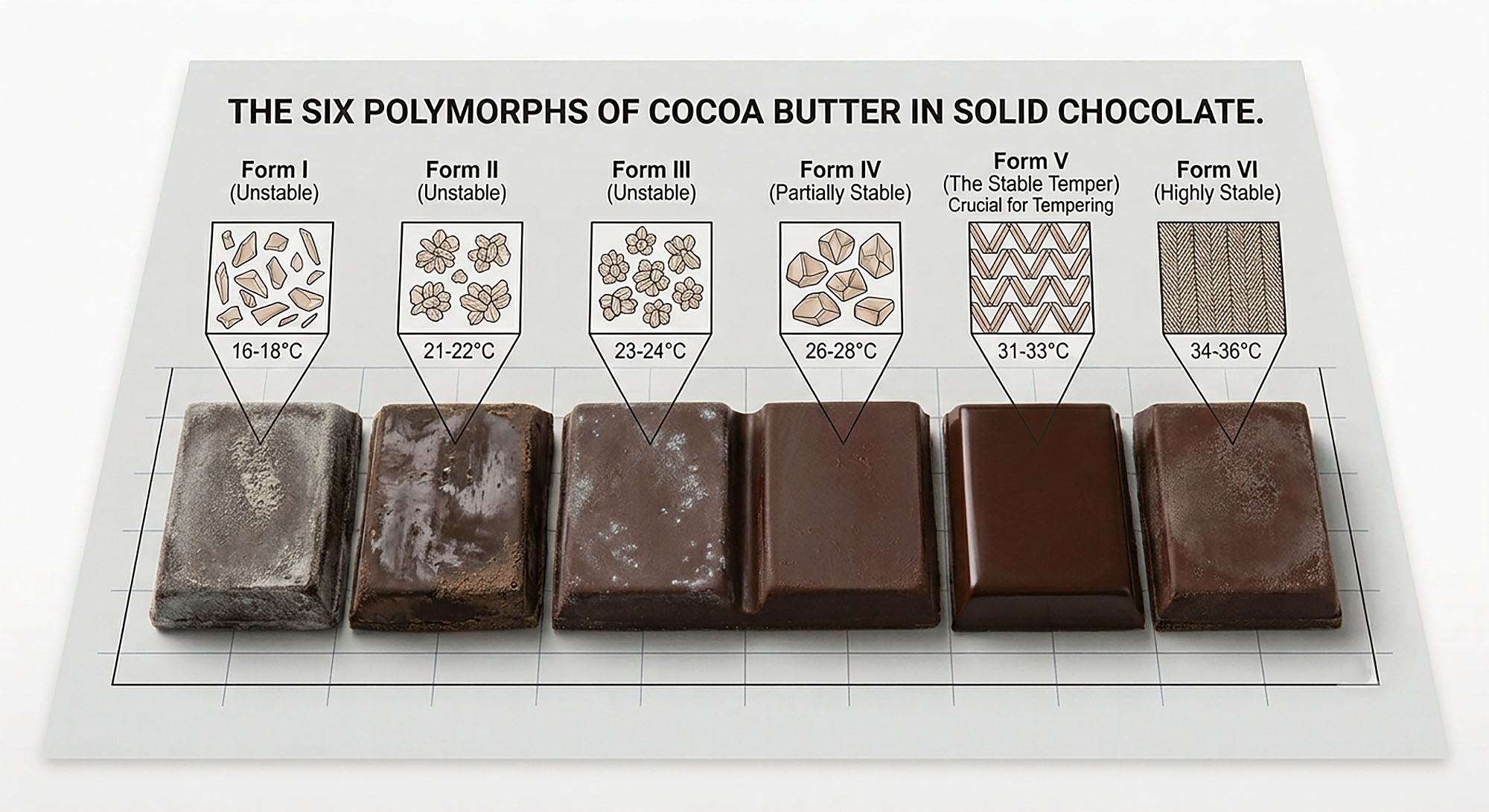
Cocoa butter is polymorphic, which simply means it can solidify into several different crystal structures. The cocoa butter itself does not change; what changes is the way its molecules arrange themselves as the chocolate cools. There are six recognised crystal forms, known as Forms I, II, III, IV, V and VI. Each behaves slightly differently, affecting the chocolate’s texture, appearance, snap and melting point.
Forms I and II produce a soft, crumbly chocolate with little or no snap. They melt very easily and are not suitable for producing a stable finished chocolate. Forms III and IV produce firmer chocolate with a better snap and more consistent texture, but the surface tends to be dull or matte and the chocolate still melts too readily.
Form V is the crystal structure we are looking for. It gives properly tempered chocolate its characteristic gloss, firm snap and stable texture. It also melts close to body temperature, which is why good chocolate begins to melt so readily in the mouth while still remaining firm enough to handle.
Form VI is the most stable of the six forms and has a higher melting temperature. It only develops after the chocolate has been tempered into Form V crystals, not on the initial solidification of the chocolate. The process of Form V crystals changing structure over time into Form VI crystals is very slow when tempered chocolate is stored correctly. In our experience, chocolate bloom can become noticeable after chocolate has been stored for a year or more.
Tempering Is Not a Fixed Recipe
There is more to tempering than simply following a set of temperatures. The conditions in the chocolate studio, and the characteristics of the chocolate itself, both affect how the process behaves. And the tempering process is used to hold the chocolate at the working temperature, whilst it is being stirred, so we can pour the chocolate into moulds to set the chocolate into bars. Holding the tempered chocolate at the working temperature, without the use of emulsifiers, is another issue that needs careful consideration.
The environment matters
Room temperature has a surprisingly large effect on tempering. Ideally, chocolate is tempered in an environment of around 21–22°C, with humidity kept below approximately 40–50%.
At MayHawk, our Chocolate Studio is an open working space, so the conditions can change with the weather. On a cold, wet day, chocolate will lose heat and begin to crystallise more quickly. On a warm, sunny day, the opposite can happen: the chocolate can be much slower to cool after tempering and moulding, making it harder to establish the Form V crystal structure we are looking for.
This means that the tempering curve sometimes has to be adjusted to suit the conditions on the day. Tempering is as much about observing how the chocolate is behaving as it is about following a temperature chart.
The chocolate matters too
Different chocolates behave differently during tempering. Dark plain, dark flavoured, milk plain and milk flavoured chocolates all have their own characteristics, and even two dark chocolates made from different origins can behave quite differently.
Some of our darkest chocolates contain only two ingredients: cocoa beans and cane sugar. Even with such a simple recipe, the resulting chocolate can vary considerably in viscosity (thickness) from one origin to another because the cocoa beans themselves have different fat characteristics. For example a Madagascan origin chocolate can be more viscous than a chocolate with cacao sourced from Ecuador. A more viscous chocolate becomes thicker as it cools and crystallises. If it is cooled too far, or held at the lower end of the tempering range for too long, it can become very thick and difficult to work with.
This is particularly relevant at MayHawk because we do not use emulsifiers such as sunflower lecithin to make our chocolate more fluid. Instead, we work with the natural characteristics of each chocolate and adjust the tempering process accordingly. An emulsifier is an industrial aid, thinning chocolate without the cost of using more cocoa butter.
A more viscous chocolate may therefore need a slightly different temperature curve and a shorter tempering cycle than a naturally more fluid chocolate. The aim is always the same — to develop the right proportion of Form V crystals — but the route to get there is not necessarily identical for every chocolate.
This is why tempering is not simply a matter of following the same temperatures for every bar. It requires an understanding of the chocolate being tempered, the conditions in which it is being made, and the way the chocolate is responding throughout the process. And it is not simply a case of ‘set and forget’, at MayHawk we are constantly recovering the chocolate as it is being stirred and held at the working temperature (for dark chocolate 30-31°C) either from over crystallisation (an over temper) or from the chocolate gathering too many other crystal forms (out of temper). There are still times when we are unsuccessful and we need to call the tempering round to an end. At this stage it is best to reheat the chocolate to 50°C and start all over again.
Hand Tempering Chocolate
What it actually feels like to temper chocolate by hand
At MayHawk, around one in ten batches is still tempered entirely by hand, on a granite slab table, and every new person who joins the production side learns to do it this way before they touch a machine. A granite or marble table is used in chocolate tempering because its dense stone surface naturally absorbs heat from melted chocolate and holds a stable, cool temperature.
The first time you hand temper chocolate on a granite or marble table your hands feel like they’re wearing thick oven mittens and your arms feel stiff, like they only move at 45 degree angles. Once this is your fiftieth batch you can feel everything under the scraper, the way the chocolate is moving and flowing, and your arms feel light, as if everything is under control, where you can push and pull the chocolate across the table with great skill.
The liquid chocolate arrives in a steel tin from the oven, fully melted at 50°C but left to cool to around 37°C, hot enough that it has no crystal memory of how it last set. We hand temper around 10Kg at a time, most of it gets poured out onto the granite table, the remaining 25% stays in the tin.
Working it across the cold stone with wide steel scrapers is what actually cools it, and it isn’t a fixed number of minutes, it’s watching the chocolate itself change: it thickens, it loses its high shine, it starts dragging slightly under the scraper rather than flowing. That’s the point at which it’s holding a temperature close to 27°C, and it’s the point where most of the crystal structure it’s going to keep has already formed. We use an infrared thermometer to check the temperature as we are working the chocolate on the table.
Why an eye and a thermometer are both needed
A thermometer confirms the number. It doesn’t tell you the rest of it, the way the chocolate behaves changes with the room, the humidity, even the time of year, so the exact moment to stop working it on the slab shifts slightly every time. That’s the part no dictionary definition or temperature chart can really convey, and it’s the difference between reading about tempering and actually doing it. The chocolate which has been cooled on the granite table to around 27°C gets stirred back in to the tin, mixed in with the 25% of chocolate that wasn’t poured out, to bring the whole batch up to around 30°C, which is deliberate: that small rise melts away any of the weaker crystal forms that formed alongside the good ones, Form V, without disturbing the ones worth keeping.
What’s left, once it settles at a working temperature, is chocolate that will set with the gloss and the snap the short answer describes, because the correct structure is already there before it ever goes near a mould.
Why this still matters even with machines available
Understanding tempering this way, by hand, before relying on a machine’s readout, changes how you judge whether a batch is actually right. A machine reports a temperature. It doesn’t tell you whether the chocolate is actually behaving the way it should at that temperature, and the two aren’t always the same thing. That’s the real reason hand-tempering hasn’t disappeared here even though it’s slower: it teaches you what correct tempering looks and feels like, so a number on a screen is never taken on trust alone.
For the full science behind what’s actually happening at a molecular level inside the chocolate while this is going on, see Crystal Structure and Tempering Chocolate. For the story of why MayHawk tempers this way in the first place, including the machine that eventually got built to do some of it, see Tempering Chocolate Machines.