MayHawk Insights 01
The Invention of the Chocolate Bar
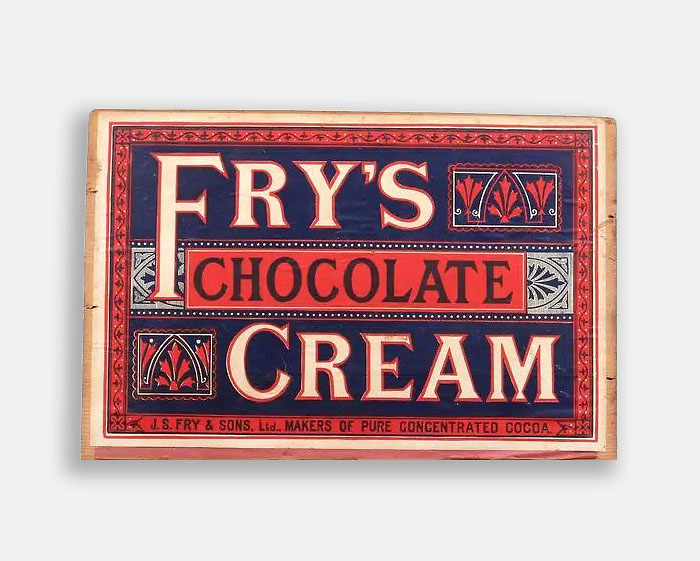
Early packaging style display box. Fry’s Chocolate Cream — the world’s first mass manufactured combination chocolate bar.
Chocolate? Make it like a brick.
“Even a brick wants to be something… It aspires. Even a common, ordinary brick… wants to be something more than it is.” — Louis Kahn.
Chocolate as Europe First Encountered It
The first clearly documented arrival of cocoa beans in Europe is 1544 — Dominican friars presented them to Philip II of Spain. There are suggestions of earlier contact, as far back as the 1520s, but 1544 is the date most historians settle on.
What arrived was not chocolate, it was a raw material for a drink. The Spanish had adapted the Aztec tradition — later removing the chilli, adding sugar, vanilla, and cinnamon — and turned it into a fashionable beverage. By the 1650s it had reached London, served alongside coffee in the new chocolate houses that were opening across the city. Those establishments became places where merchants, writers, and politicians met to conduct business — some of the most consequential conversations of the age conducted over a cup of something that had started life as a drink bound up in religious and political life in the forests of Mesoamerica.
A chocolate bar simply did not exist. The idea of chocolate as something you could carry, unwrap, and eat was still two hundred years away.
It took so long because the solid chocolate bar was not a sudden discovery. It was a series of industrial iterations, and accidents, that transformed an aristocratic drink into something democratic — a personal pleasure made for everyone.
The Invention That Made the Bar Possible
Cocoa beans are made up of around half fat and half solid. In 1828, a Dutch chemist named van Houten developed a press that could separate the fat from a roasted cocoa bean — extracting what we now call cocoa butter, and leaving behind a dry cake that could be ground into cocoa powder. The powder is what the industry wanted, and what we are accustomed to today. Hot chocolate drinks could now be commercially made without the fat.
So, the press was useful. But on its own, it did not change what chocolate could be. It was developed as a new process to improve the drink. The real change came from understanding what to do with the unwanted mass, the cocoa butter.
The Great Solidification
In the UK, in 1847, Joseph Fry of Bristol, the grandson of the founder, took the extracted cocoa butter and recombined it with cocoa liquor and sugar to make a mouldable paste. Pressed into a mould and allowed to set, the result was the world’s first commercially available solid ‘eating chocolate’.
Not a drink. A bar. Chocolate that could be eaten.
1847 was only the start. This innovative chocolate tablet, a simple rectangular solid shape that could be eaten, was the germ of an idea that Fry needed. Alongside the tablets, launched in 1866, Fry’s Chocolate Cream became the world’s first mass-manufactured combination chocolate bar, which is still available to buy today. And in 1914 Fry’s Turkish Delight was first sold.
In 19 years (1847-1866) J.S. Fry & Sons Ltd in Bristol, UK, had made the world’s first mass-manufactured chocolate bars, and chocolate combination bars.
We would instantly recognise the modern format of Fry’s 1866 Chocolate Cream bar — a smooth fondant cream centre enrobed in a plain dark chocolate. An idea later copied and iterated upon.
Smoothness. I just forgot to turn the machine off.
If, in 1847, the solid form was solved in Bristol — smoothness was solved in Berne.
A smooth texture to solid chocolate was perfected in 1879 when a 24-year-old Rodolphe Lindt in Switzerland invented the conche. The discovery was, famously, an accident. Lindt had been working towards making a smoother chocolate in his Berne factory, and on one Friday evening he left the factory to go home, without turning the mixing machine off he had developed. It ran continuously over the weekend.
When he returned on Monday, the chocolate inside had transformed — three days of continuous agitation at heat had driven off excess moisture and volatile acids and distributed the cocoa butter evenly through the mass. The result was something that had not existed before: chocolate that genuinely melted on the tongue. Lindt called his machine the conche — from the Spanish word for shell, describing the shape of the original trough. He called his product ‘chocolat fondant’. It was an immediate commercial success.
Why Milk Changes Everything
Milk chocolate, in a bar form, came about from trying to solve a different problem entirely.
Chocolate reacts poorly to moisture — liquid milk when added would split the texture, and never truly solidify. The solution arrived in 1875, when Swiss maker Daniel Peter, working alongside his neighbour Henri Nestlé, finally managed to marry cocoa solids with condensed milk into a solid form. He called it Gala Peter — gala from the Greek for milk — and it became the template for the most consumed form of chocolate in the world.
But why does milk alter chocolate so profoundly, that in certain ways it rivals dark chocolate as its twin? The same question applies to hot chocolate — it tastes better made with milk than with water, and the three reasons are specific and surprising. Milk fat carries flavour in suspension. While Casein, milk’s primary protein, binds to the bitter compounds in cacao and neutralises them. And Lactose adds a background sweetness that enhances without overpowering, and encourages the caramelised depth that defines milk chocolate’s character (which Cadbury’s harnessed).
Three mechanisms. All of them invisible. Together, they produce the taste of milk chocolate as we know it today.
The Golden Era — and the Bars Still Being Sold
In just under thirty years, 1847 to 1879, the modern chocolate bar — dark and milk — had taken its definitive form. Fry’s, Cadbury’s, and Rowntree’s became the UK’s most famous brands, with Cadbury’s Dairy Milk (1905) becoming the UK’s favourite ‘standard’ chocolate bar. Which it still is, with over 350 million bars sold in the UK every year.
Yet the ‘golden age’ of chocolate was arguably from the 1920s to the mid-1930s. This era saw the creation of some of the world’s most beloved and enduring ‘combination’ and new ‘texture’ bars: 1920 (Baby Ruth, USA), 1923 (Flake, UK), 1923 (Milky Way, USA), 1928 (Reese’s Peanut Butter Cups, USA), 1929 (Crunchie, UK), 1930 (Snickers, USA), 1932 (Mars Bar, UK), 1932 (3 Musketeers, USA), 1935 (Kit Kat, UK), and 1937 (Aero, UK) among others.
These are not historical artefacts. They are current products. Snickers, invented in 1932, is the world’s best-selling combination chocolate bar, with annual global sales consistently surpassing $2 billion. While Kit Kat, from 1935, — a biscuit or a chocolate bar, the debate genuinely rages — is what Nestlé calls one of its ‘billionaire brands’, and is not far behind, with consistent double-digit growth year on year.
Cadbury’s, Mars, Lindt, Nestle, these are economic power-houses with a long history of making successful chocolates and innovating on trends. For example in the UK, in 1868, Richard Cadbury (son of the founder) started packing chocolates into beautifully decorated, heart-shaped “Fancy Boxes” to increase sales leading up to the 14th of February. Valentine’s Day and chocolates were linked together forever because of the sales instincts of Richard Cadbury. These ornately decorated boxes were prized as keepsakes, that Victorians later used to store love letters in.
Chocolate and the Quaker Families
It is worth pausing here to look at who contributed most to making chocolate popular in the UK. The three companies, Fry’s, Cadbury’s, and Rowntree’s, are the three main companies, since the Victorian period, who went on to define British chocolate.
All three were family run companies founded by Quakers. Fry’s as a ‘chocolate’ company was officially founded in 1761, when Joseph Fry purchased a cocoa business he had worked at in Bristol — this was driven by the Quaker belief that drinking cocoa was a healthy and nutritious alternative to alcohol.
For these families, how a company treated its employees mattered as much as the profits it made. Cadbury built an entire village for their workers outside Birmingham. Rowntree’s did the same in York. This was at a time when industrialisation brought terrible living conditions to the British working class and these Quaker families looked to remedy that.
Sixty-Nine Years That Shaped Everything
1847 was the revolution in Bristol. But consider this timeframe. From 1866 and Fry’s Chocolate Cream to the Kit Kat in 1935 is sixty-nine years. Via dark and milk chocolate bars, and combination bars, most of what the world eats as chocolate today — the forms, the formats, the combinations — was established within that short window. The century that followed added scale, marketing, and industrial processing. But, in truth, it did not add much that was genuinely new. Old favourites are old, and yet not that old when you consider how long it took to perfect going from a chocolate drink to a solid bar.
Doing something new is easy. Doing something better is hard. Anyone can add an inclusion to the back of a chocolate bar to make something new — the harder question is whether it is better. This is what we seek out at MayHawk.
TLDR: The British made the first commercial chocolate bar in 1847 — but almost nothing great is made in isolation. It takes iterations, accidents, and adjacent inventions. At MayHawk we understand this. Small though we are, as Louis Kahn put it — we aspire.
Conner. 12th May 2026.
Conner. Copyright MayHawk.
All rights reserved. No part of this publication may be reproduced, distributed, or transmitted in any form without prior written permission.