MayHawk Insights 02
Theobroma Cacao — The Tree at the Beginning of Every Bar
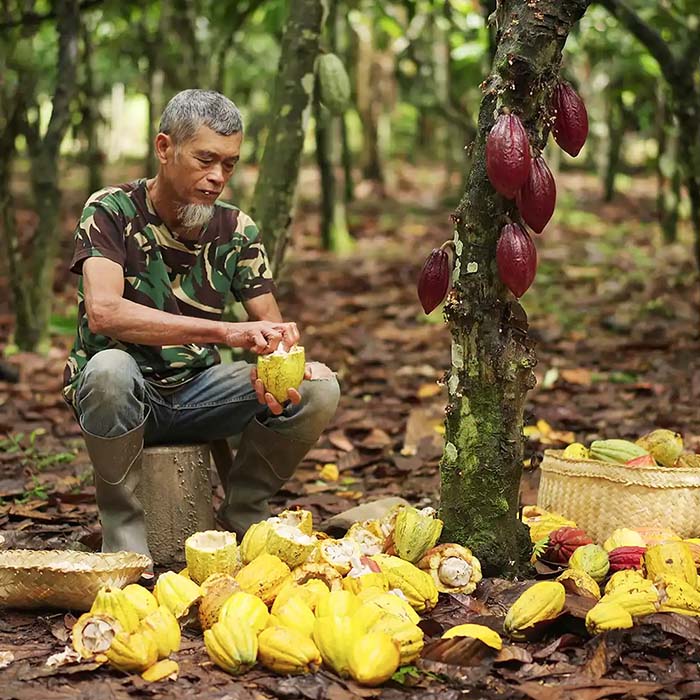
A plantation worker harvesting cocoa pods from a cacao tree.
“All food is the gift of the gods and has something of the miraculous, the egg no less than the truffle.” — Sybille Bedford
Theobroma Cacao — The Tree That Makes Chocolate
The scientific name for the cacao tree was given by the Swedish botanist Carl Linnaeus in 1753 — the same taxonomist responsible for the binomial classification system that organises all known plant and animal life. Theobroma draws from the Greek: theos for god, broma for food. Food of the gods. The name was not chosen casually.
The cacao tree is a small evergreen with a deep taproot — an anchor against the seasonal flooding common across the tropical regions where it grows — reaching around twenty-five feet in height and living for seventy years or more. It begins bearing fruit at three to five years of age, reaches peak productivity between ten and thirty years, and can remain productive well beyond that.
Its closest relatives are ones a British garden would recognise — the Hollyhock, the Hibiscus, and the common marsh mallow. All belong to the Malvaceae family, and all share the cacao tree’s characteristic five-petalled flowers.
Cauliflory — A Tree Built Around Its Fruit
What distinguishes the cacao tree from its cousins is a feature called cauliflory — the growth of fruit directly from the wood of the main trunk and the oldest primary branches, rather than from the outer canopy. This is not an anomaly. It is a structural adaptation. The cacao pod is heavy; the tree’s outer branches could not support its weight. The trunk provides the necessary anchor.
Each pod contains around forty seeds — the cocoa beans from which chocolate is made — cushioned within thick mucilaginous membranes that protect them from insects and tropical conditions. Those membranes — the mucilaginous pulp surrounding each seed — are rich in sugars. During fermentation, that pulp is what yeasts and bacteria consume, generating the heat and acids that begin transforming raw cacao into something that can become chocolate.
The pods grow from specialised sites on the bark known as flower cushions — points that remain active for decades. At harvest, precision matters. If a pod is pulled away carelessly and the flower cushion beneath it is damaged, that site will not flower again. The loss is permanent.
The flowers produced by these cushions are too small for conventional bees to pollinate. Pollination depends instead on the Ceratopogonidae — biting midges no larger than a pinhead — to carry out the work that bees perform for most of the crops we grow. Without them, there are no pods. Without the pods, there is no chocolate.
Where the Cacao Tree Grows
The cacao tree is not a tree that grows everywhere it is planted. It demands a specific set of conditions — and those conditions are narrow enough that the map of where cacao is grown tells you a great deal about what the chocolate made from it will taste like.
The cacao belt is the band of tropical territory running twenty degrees north and south of the equator. Within it, the tree requires consistent warmth — between 21°C and 32°C year-round — high humidity, significant annual rainfall, and partial shade.
In its natural habitat it grows beneath the forest canopy, protected from direct sun and wind. When cultivated, it is typically grown under shade trees that replicate those conditions. Remove the shade, push the temperature, reduce the moisture, and the tree produces — but not well, and not for long.
Why Where It Grows Matters
Altitude is part of it. Cacao grown at higher elevations, where temperatures are cooler and the growing season longer, tends to develop greater flavour complexity.
The Huila region of south-west Colombia sits at altitude in the Andes. The Sambirano Valley in north-west Madagascar benefits from fertile volcanic and alluvial soils, enriched by river silt. The Upper Huallaga Valley in Peru’s Amazon basin draws from a dense lowland microclimate of its own.
These are not interchangeable environments. They produce cacao that is not interchangeable in character. No two origins produce the same bean, the same flavour potential.
This is why origin matters in fine chocolate — and why the selection of sourcing regions is a technical decision as much as an ethical one. The bean carries the environment it was grown in. The soil and mineral makeup, the rainfall pattern, the altitude, the shade — all of it arrives in the finished bar if the cacao is treated well enough to let it.
MayHawk sources single-origin cacao from eight regions across the cacao belt, selected for the precision and complexity of their growing conditions. The full sourcing map is here.
The Tree That Civilisations Built Around
The Olmec — the first great civilisation of Mesoamerica — were using cacao in ceremony and exchange as far back as 1800 BCE. We don’t know this from written record — the Olmec left none — but from theobromine residues confirmed in excavated pottery at San Lorenzo, their capital. They had monumental architecture, a developed artistic tradition, long-distance trade networks, and evidence of complex social hierarchy. San Lorenzo was a substantial urban centre.
The cacao they used came initially from wild trees encountered in the forest. Then individual trees were tended at the forest edge, a basic cultivation creating the conditions the tree itself needed to thrive.
The drink prepared in those earliest vessels was likely fermented from the sweet pulp surrounding the seeds. The grinding of cacao beans came later. The reverence came first.
The Maya wove it into marriage rites and daily life. The Aztecs formalised what their predecessors had begun. Cacao beans became currency across the empire — demanded as tribute, stockpiled, traded. The drink they called xocolātl, bitter water, was cold, spiced with chilli and vanilla, reserved largely for the ruling class. To drink it was, in a direct sense, to drink money.
The Spanish Influence
Hernán Cortés arrived in Mesoamerica in 1519 looking for gold. He found an empire that used beans as money. The Spanish conquest that followed was systematic and brutal — but among what came back to Europe in its wake was a quantity of cacao, encountered at the court of Moctezuma II and carried home more as curiosity than prize.
Later, the Spanish added sugar and heat. The bitter cold drink of the Aztec elite became something else entirely. The solid bar came much later — through several centuries of refinement, industrialisation, and invention that the conquistadors could not have imagined.
All food is the gift of the gods… but the tree that Linnaeus would name had been treated as exactly that for nearly three thousand years before he reached for the Greek dictionary.
TLDR: The cacao tree is one of the most constrained food plants in cultivation — architecturally specific, geographically narrow, pollinated by an insect most people will never see. It grows only where conditions are precise. The chocolate it produces is only as good as the environment that shaped it. Origin is not marketing. It is biology.
Conner. 19th May 2026.
Conner. Copyright MayHawk.
All rights reserved. No part of this publication may be reproduced, distributed, or transmitted in any form without prior written permission.