MayHawk Insights 05
The Chocolate House — Deadbeats, Actors, Politicians, & Gamblers
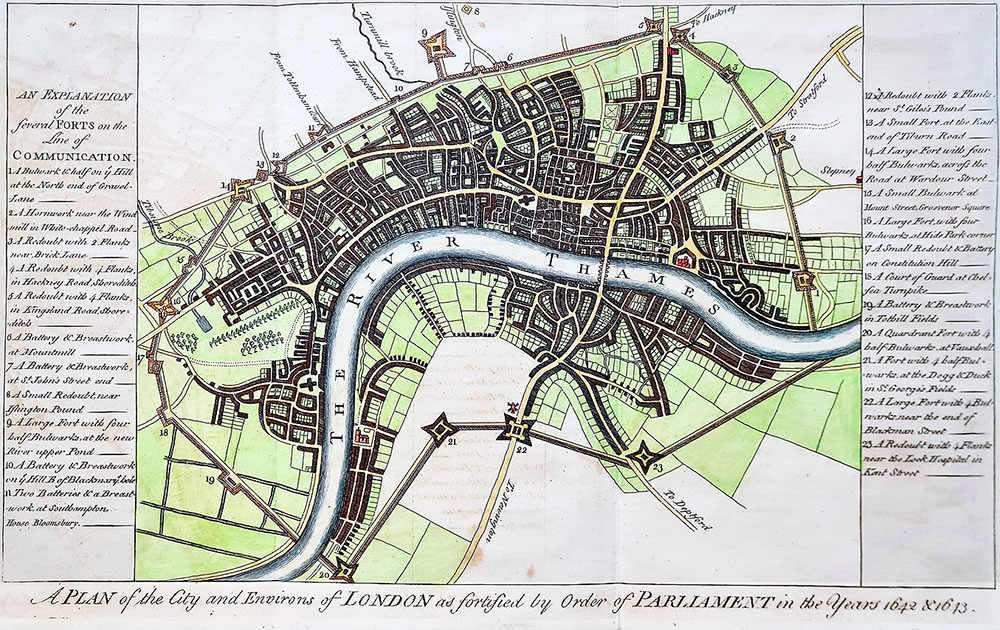
Map of London 1642. Approximately 400,000 people lived in London at this time.
“…to a Coffee-house, to drink jocolatte, very good; and so by coach to Westminster.” — Samuel Pepys, 24 November 1664
A European Invention, a London Institution
The chocolate houses of the mid 1600s were not establishments unique to London, but they were the most fashionable. By the mid-seventeenth century, chocolate as a hot drink had been sedately moving through Europe for over a hundred years. London, meanwhile, had done something different with it.
London has always been a noisy place. That hasn’t changed, but thankfully the smells have. In the 1600s, outside the social gathering places of the day, were yards and stables reeking with dung on the floor, while the inner sanctums were standing room only — walnut shells cracking underfoot. Business inside was usually conducted at a fast pace, or more leisurely, if the cards fell right. The noise and vitality set these chocolate houses apart from the ones on the continent, everybody talking together, breaking nuts, and crying out for more ale, or coffee, or chocolate.
The first chocolate house proper in London opened on Queen’s Head Alley, Bishopsgate, in 1657. Within a decade the city had dozens. Fewer after the Great Fire. But before then, in 1664, Pepys wrote the casual aside of a man recording a perfectly ordinary afternoon — chocolate had become part of the texture of London life. Not remarkable enough to explain. Simply good.
London is not a civilised, nor a graceful city, in the same mould as the great European cities. But it is exciting, the way they never can be. This is a city built upon profit and speculation, with an organic will of its own.
In the 1660s, if you could afford it, you knew the coffee houses served coffee, chocolate, or ale, with buttered toast. And the chocolate houses served chocolate, coffee or ale, with buttered toast. Not glamorous, yet it was anything but boring.
The Room
Step through the door of a London chocolate house in the 1660s and you would be stepping into something that has no modern equivalent. Certainly not a café. Somewhere between a public house, rowdy nightclub, and a casino, depending on the establishment.
The Chocolate House, White’s on St. James’s Street, was the haunt of the aristocracy — beaux, wits, and gamblers, the air thick with roasting cocoa and the sound of fortunes being made or lost. The Cocoa Tree on Pall Mall was quieter, the sanctuary of the Tory political establishment. Both ran on chocolate. Both understood that the drink was merely the occasion. What people came for was the room.
The interior of White’s was a snug by any honest measure. Low ceilings, tallow candles, the permanent smell of roasting cocoa beans over charcoal. Wool coats steaming dry from the cold outside. The chocolate arrived in a shallow dish, drunk standing or at long communal tables, the person beside you as likely a spy as an earl. Gossip, stock tips, political scandal — the serious business of the day conducted in the warmest room available. It was loud, close, expensive, and entirely alive. Nobody came for the quiet.
In 1693, two customers drinking chocolate at Bridges Street, off Drury Lane, were brought before the Old Bailey — they had been conspiring to commit a murder. It was that kind of place. A parliamentary Act of 1606 had earlier condemned Drury Lane and its environs as “deepe foul and dangerous to all who pass those ways.”
By the 1690s the Lane was home to a lively gathering place where actors, writers, and playwrights from the nearby theatres socialised and debated. Unlike the elite, gambling-heavy establishments of St James’s Street, the Drury Lane and Covent Garden chocolate crowd tended toward the rougher and more bohemian.
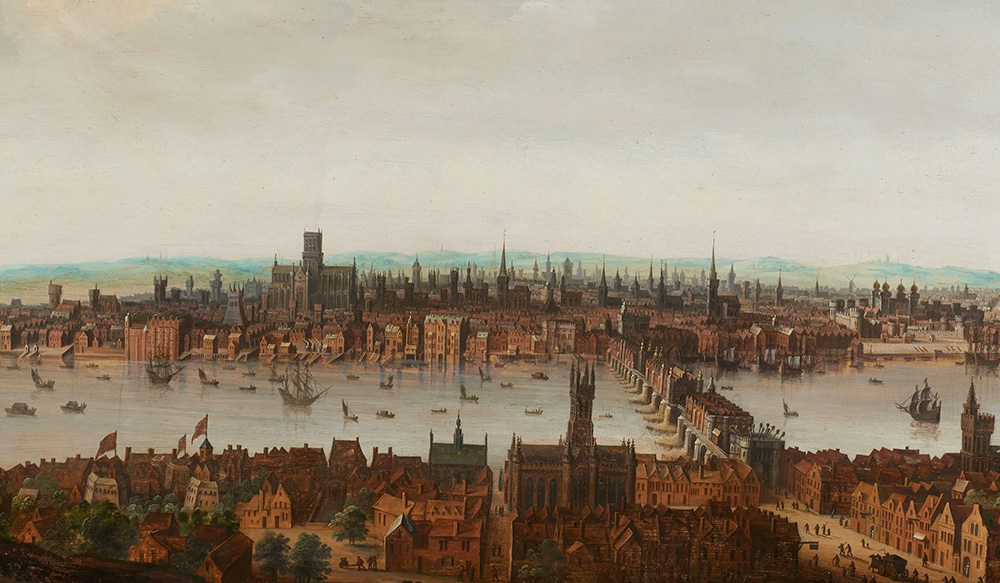
Dutch School (artist unknown). London circa 1630. This view of London from Southwark depicts the capital as you would have found it in the 1600’s. The view was drawn from the church tower of St Mary Overy and Old London Bridge features prominently to the right of the picture — built between 1176 and 1209, it was the first stone bridge to cross the Thames, famously filled with houses, shops and a chapel.
The Problem With the Drink
If we could step into the room of one of these chocolate houses, we wouldn’t recognise the hot chocolate they were drinking — in White’s it was also expensive, sixpence a dish at a time when a working man earned less than a shilling a day.
Cocoa beans are made up of roughly fifty percent fat. When the beans are roasted and ground down, in hot water, that fat melts and separates — a yellow film of cocoa butter rises to the surface, and the drink arrives in the cup looking as unstable as it tastes. Sweetened with sugar, spiced with cinnamon or vanilla to soften the bitterness, it was an acquired pleasure. Expensive, fatty, and temperamental. The room was the point. The drink was the excuse.
Jamaica, 1687 — An Improvement
In 1687, a young Irish physician named Hans Sloane sailed for Jamaica as personal doctor to the Governor, the 2nd Duke of Albemarle. He arrived as a scientist — collecting plant specimens, cataloguing fauna, documenting everything he encountered with the methodical precision of a man who would one day found the British Museum.
This is what we know. In Jamaica he encountered a cacao drink prepared with water. He found it nauseous. He asked for milk instead — this was a request, it was not offered to him as an alternative. Some accounts credit other origin stories. But what the record confirms is this: in 1687 Sloane added milk to a cacao drink instead of water. As a physician he found the result not merely tolerable but healthy. Impressed with what he had made, he carried his version of the recipe back to London where he sold it through apothecaries as a medicinal preparation.
Milk, being a natural emulsifier, improves on the water version of the drink through three processes. Milk fat carries flavour in suspension. While Casein, milk’s primary protein, binds to the bitter compounds in cacao and neutralises them. And Lactose adds a background sweetness.
Sloane’s recipe became a commercial success when it passed eventually to Nicholas Sanders and William White, who manufactured and sold it. Later still, it reached the Cadbury family — who understood, earlier than most, what it might become.
Van Houten and the Problem Finally Solved
The fat problem of the cocoa butter, that had troubled the chocolate houses since the 1650s, was not truly resolved until 1828, when a Dutch chemist named Coenraad van Houten developed the cocoa press.
The principle was straightforward. The roasted cocoa nibs — the inner meat of the bean — were pressed under hydraulic force, extracting the cocoa butter and leaving behind a compressed cake of defatted cocoa solids. That cake, milled into powder, dispersed cleanly and reliably in hot liquid for the first time. No film of fat rising to the surface. No larger particles sinking. A stable, smooth drink.
Van Houten went further. By treating the cocoa during roasting with an alkaline solution — a process that became known as Dutching — he found he could improve the powder’s solubility, reduce the acidity further, and adjust its colour from a pale brown to something darker and more consistent. The modern hot chocolate powder, to make the drink we know, had arrived in a manually operated Dutch factory in 1828.
The Cadbury brothers purchased Van Houten’s system and used it. The drinking chocolate they manufactured in the UK, from the 1850s onward, was built on his process. The chocolate house tradition that had continued into the Victorian age — the drink, the room, the ritual — had found the technology it had always needed. Cadbury did the rest. The expensive, fatty, bitter drink for the rich, that had cost sixpence a dish in White’s, would eventually reach everyone.
Things Change.
White’s chocolate house eventually became White’s club — the oldest and most exclusive gentlemen’s club in London, still standing on St. James’s Street today. The Cocoa Tree evolved similarly. The cocoa drink faded from the centre of the room; the room itself persisted.
The London coffee houses and chocolate houses of the seventeenth century were not simply places to buy a drink. They were the city’s operating system — the rooms where its politics were conducted, its money moved, and a person’s reputation could be made or destroyed. The drink was the cover charge. The conversation was the point.
The Room, Revisited. No Nuts on the Floor.
The chocolate house never entirely went away. It changed address, changed form, and eventually changed scale. You can still buy a hot chocolate at a café chain in London, or a better one at an independent coffee house.
Hot chocolate as a drink is still important to modern day life. The global hot chocolate market is currently valued at over $20 billion. Yet, after decades in which instant powder and the supermarket shelf defined what hot chocolate was meant to be, something in the market is shifting.
Coffee led the way. The modern coffee scene created a consumer who understood that how a coffee was made mattered, and was prepared to invest accordingly. To make it ‘properly’ at home, consumers are now buying high quality domestic coffee and espresso machines.
Your living room might be without the gambling, gossip, plots of murder and dung outside — but hot chocolate is following the same arc as coffee. The machine is not as fancy, and it’s a decade behind, but you can now buy a domestic appliance designed for one purpose: to produce a better, smoother, properly emulsified hot chocolate from real chocolate at home. So, it looks like we are back to drinking ‘chocolate’ again, just like in 1660s London.
TLDR: The London chocolate house was never really about the chocolate. It was about what a warm room and an expensive drink could make possible — the conversation, the deal, the scandal, the intelligence. The drink itself was fatty, temperamental, and difficult. It took 200 years to make a drink that we now take for granted.
Conner. 2nd June 2026.
Conner. Copyright MayHawk.
All rights reserved. No part of this publication may be reproduced, distributed, or transmitted in any form without prior written permission.