MayHawk Insights 06
Form Over Function — Why Good Design Matters Even In Chocolate
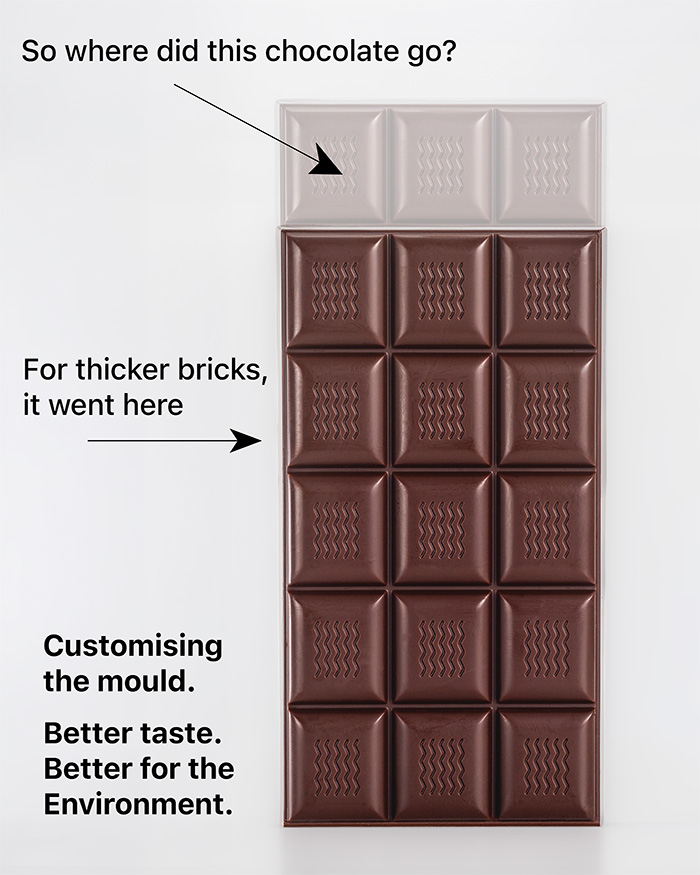
This is a chocolate bar made by MayHawk, using a customised chocolate mould.
“Good design makes a product useful.” — Dieter Rams
What is Good Design?
This question, in industrial design, has been asked for as long as things have been made — and an honest assessment is that any answer has always been incomplete — or a list of bullet points.
William Morris tried to answer the question in 1880. “Have nothing in your houses that you do not know to be useful, or believe to be beautiful.” Morris was not just making an aesthetic argument. He was making a moral one (a personal conviction). He was reacting against a new industrial world producing things at scale that had forgotten the person at the end of the process. A new consumerism driving affordable mass production.
Dieter Rams, an industrial designer at Braun, tried to answer the same question in 1976, from a slightly different direction. He looked at a world around him, a world that Morris had watched arrive, and described it as “an impenetrable confusion of forms, colours and noises.” He asked himself whether his own work was contributing to that confusion or resolving it. His answer became his ten principles — his guardrails. Ten principles that have inspired a whole new generation of designers. Four of them are worth noting here.
Good design makes a product useful. Good design is honest. Good design is thorough down to the last detail. Good design is as little design as possible — famously distilling all ten principles down into the famous, “Less, but better.” mantra.
Jony Ive spent his career at Apple applying those principles to consumer technology, at an unimaginable scale — with Apple, under Ive’s design team, selling 230 million iPhones in 2015. His formulation on good industrial design was similarly precise: “Simplicity is not the absence of clutter, that’s a consequence of simplicity.”
So, perhaps it might be better to state what good industrial design is not, and then say what it is.
Good industrial design is not only about aesthetic preference, it also has functional standards.
A product that does not serve the person using it has failed, regardless of how it looks. The lineage from Morris to Rams to Ive is not coincidental. It is one continuous argument, refined across 150 years: an object exists to serve the person using it. Everything else, as Rams says, is noise.
What Bad Design Looks Like
Bad design is not difficult to identify. It announces itself — unfortunately it is becoming more frequent that problems with design surface after the product has shipped, usually at the point of failure, and usually at someone else’s expense.
The Xbox 360 launched in 2005 to considerable acclaim. Its designers had worked, by their own subsequent account, backwards — arriving at a housing they liked the look of, and then attempting to fit the technology inside of it. The catastrophic thermal consequences of that decision were not immediately apparent. Three flashing red lights (infamously called RROD) said otherwise. Sold in the millions the failure rate reached 54 percent in some surveys. Microsoft spent over $1 billion repairing returned Xboxes. (“Good design is thorough down to the last detail.” — Rams)
The DeLorean DMC-12 car arrived in 1981 carrying its ambitions visibly. Stainless steel body. Gull-wing doors. But it was slow, with poor reliability, and several build quality issues from the first production run. It became iconic not because it worked, but because a film about a Time Machine made it immortal, (the DeLorean notoriously broke down constantly on the film set). Form over function. (“Good design is long-lasting.” — Rams)
Architects in post-war Britain and America were certain about the Tower Block as a housing solution for the growing cities. The logic was compelling on paper. The Tower Block was going to create a modern utopia, a ‘Streets in the Sky’. Within a generation, these certainties had collapsed, along with many of the buildings. Entire estates, hailed at their opening as the solution to the housing problem, were demolished before their fortieth birthdays. Today, even more of these city tower blocks are condemned for demolition — 1960s and 70s tower blocks are being knocked down to make way for modern, low-rise affordable housing. Tower Blocks of this era were complete failures of design — built around progressive ideology, not the people living inside of them. (“Good design makes a product useful.” — Rams).
Three industries, three scales, three different kinds of failure. The same cause in each case: the designer’s vision placed ahead of the user’s experience.
The Craft Chocolate Mould — And Temptations
Industrial design, is industrial design, no matter the industry. At MayHawk we have two small integrated studios, where we do mostly everything in-house. The Chocolate Studio works on the edible side of our business, while the Design Studio works on everything we produce that people don’t eat.
The Design Studio thinks deeply about the question we raised at the beginning. What is good design?
The custom chocolate mould has become, in the last decade, a status symbol within the craft chocolate sector. Expensive. Architecturally ambitious. Logo-embossed. Made by designers with no particular experience of chocolate — of how it flows, how it releases, how it breaks, how it melts. The temptation for the redesign is that it looks cool, it’s one of a kind, it brands your chocolate bar.
The results are visually distinctive bars… Which are frequently a nuisance to eat.
These are bars that splinter unpredictably. Pieces that resist breaking cleanly. Surfaces that prioritise the brand’s visual identity over the physical experience of the person breaking a square and placing it on their tongue. A fast melt, with no taste sensation clearly defined. Broken crumbs on the table, or on your white shirt.
This is not a new failure. It is the DeLorean applied to chocolate. Form over function. The chocolate company or brand owner succumbed to temptation. They made what they wanted. Ego led. With no thought to the customer consuming the chocolate. This sounds like a harsh criticism, but where was the designer they hired pushing back on this? Morris would have recognised it immediately. An object made without respect for the person using it. Beauty as decoration, not as consequence. (“Good design is honest.” — Rams).
The MayHawk Design Studio — Two Years and a Better Question
“I have not failed. I’ve just found ten thousand ways that won’t work.” — Thomas Edison.
If you look closely at a MayHawk chocolate bar and then at a Dandelion Chocolate bar, you might think we use the same mould. We do. But it’s a standard, commercially available, off the shelf polycarbonate mould that several other craft chocolate makers also use. It happens to be really good.
Yet, look closer. There are five rows on our bar, instead of six. Something has changed.
What changed was the question being asked. Not: how should this bar look? But: how should this bar eat?
The MayHawk Design Studio has been working on a custom mould for over 12 months. It has been through iterations of 3D printing and testing. We still don’t believe it’s ready. Edison was right — there are ten thousand ways that won’t work, and the process of elimination is the work. Rushing toward a solution because a new shape is available is precisely the temptation the craft sector has been unable to resist.
So in the meantime, we studied what already existed, and bought a commercially available chocolate mould that conformed to ‘good’ design.
That is the one. For now.
The mould we are using has all the hallmarks of the classic chocolate bar format — regular bricks, calibrated break points, the satisfying snap. A format largely perfected by the Victorians. Each piece engineered to melt evenly on the tongue. It is easy to dismiss as ordinary. But it has passed the test of time that most new mould designs have not yet approached. This classic form has served the person eating it, and it has kept serving them for over a hundred years.
But we changed it. Slightly. Our customisation addressed one specific thing. Length x Width x Brick Thickness: with a standard Volume of Chocolate.
How did we customise it? How is the top row removed? No, we don’t use a knife to cut the top off the chocolate bar. We worked it out. Logically. Tested it, and then did the customisation for all our moulds.
We still use the same weight of chocolate. Over a smaller surface area. Making thicker bricks. The result is a slower melt on the tongue — and in chocolate, a slower melt means a longer release of top-note flavours. The difference is measurable. The smaller footprint, even with thicker bricks, means our packaging is smaller than most chocolate bars, with a direct effect on logistics and our carbon footprint. Also our packaging designs and artwork suit this specific height x width ratio much better than leaving it thin and narrow.
The science, art and the environmental arguments all pointed in the same direction. That is not a coincidence. This is what happens when the questions being asked are the right ones. We did not remove a row of chocolate to save money. It’s the same volume of chocolate. We removed it to improve what eating the bar actually feels like and how we package it. (“Good design makes a product useful.” — Rams).
The custom mould we are still developing will be released when it is ready. Not before.
TLDR: Good design is not what you add. It is what you notice. And sometimes, what you take away.
Conner. 9th June 2026.
Conner. Copyright MayHawk.
All rights reserved. No part of this publication may be reproduced, distributed, or transmitted in any form without prior written permission.