MayHawk Insights 10
Crystal Structure and Tempering Chocolate — Part One: The Science
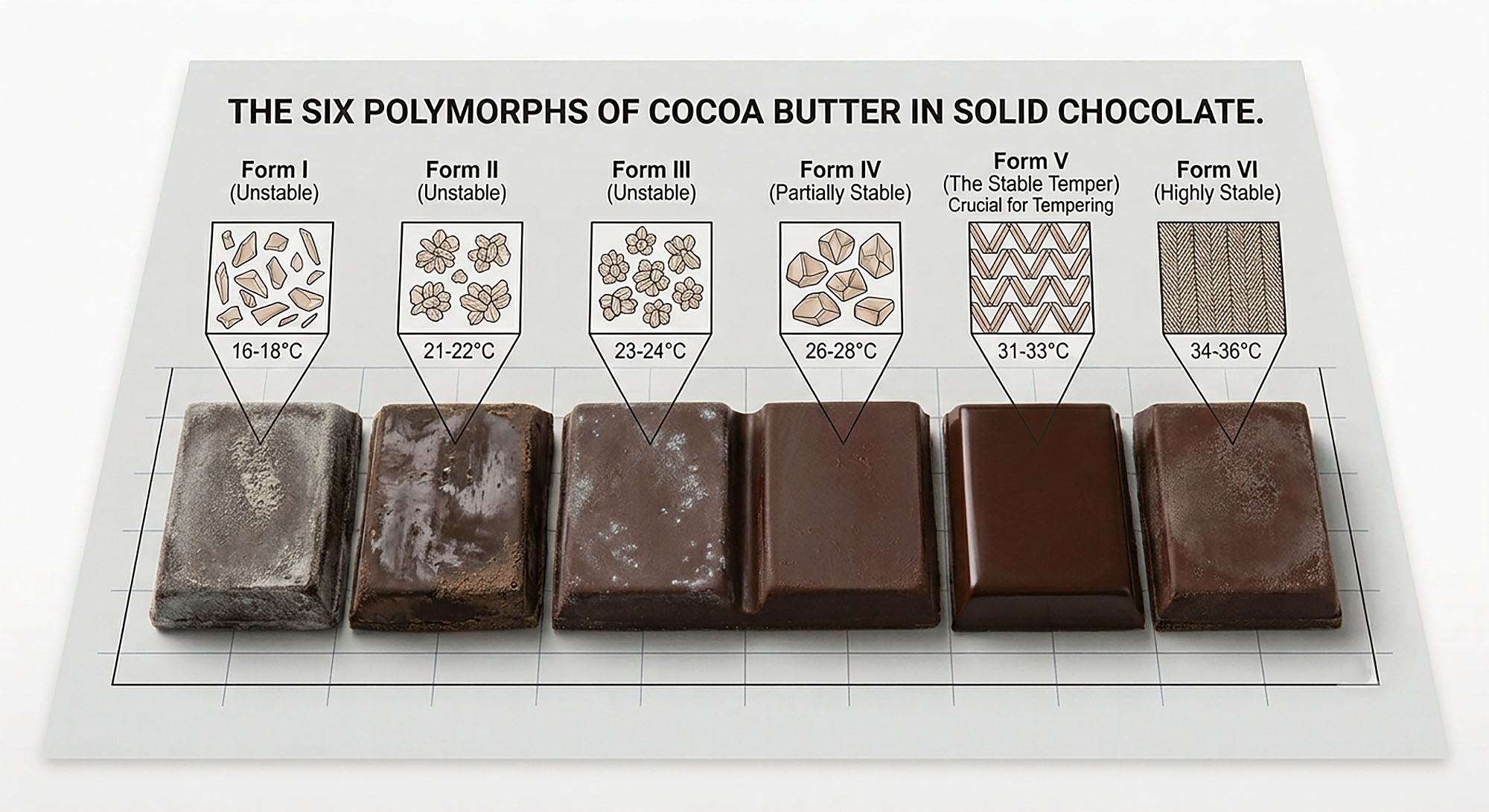
The Six Forms of Cocoa Butter Crystals in Solid Chocolate and the approximate range of temperatures showing the melting/cooling points of each. Form VI is created from Form V over time.
“Nature uses only the longest threads to weave her patterns, so that each small piece of her fabric reveals the organisation of the entire tapestry.” — Richard Feynman
The world’s first mass-produced eating chocolate appeared when Fry’s of Bristol, in 1847, began selling solid chocolate bars. That sounds simple. But chocolate, at room temperature, is a solid made from crystallised cocoa butter, and cocoa butter can solidify in several different ways. Only one of those ways produces the bar a chocolate maker actually wants to sell.
What ‘In Temper’ Actually Means
Cocoa butter has an uncommon property that means it can crystallise into several distinct structures from the same molecules. Nothing about the chemistry changes. It’s the same fat, the same triglycerides, but arranged differently at the microscopic level. Each arrangement of the crystal structures behaves differently — different melting point, different hardness, different appearance, different feel on the tongue. Same taste.
This property is called polymorphism. It is not unique to chocolate — many fats and minerals display it — but in chocolate that you want to sell, it is the entire difference between success and failure. Get the wrong crystal structure and the chocolate will still taste of chocolate, but to a customer it will not look right, snap right, or melt right. It also may turn pale and streaky within days, and this is not what a paying customer is paying for. This is what ‘out of temper’ means. Tempering is not a finishing flourish. It is the process of choosing, deliberately, which of several possible crystal structures the fat will adopt when cooled to a solid. And it is the job of a chocolate maker like MayHawk to understand this and control the crystal growth in the tempering process.
The Six Crystal Forms
The main thing to hold at the front of mind while reading this section is that cocoa butter can cool into six different crystal forms. And the cocoa butter we are discussing here is natural cocoa butter, not the deodorised kind. Deodorised cocoa butter follows the same science, but with small differences in melting points. Deodorised cocoa butter has undergone a physical refining process (usually steam stripping under a vacuum) to remove its distinct chocolate aroma and flavour creating a blank canvas to add into chocolate without altering the taste.
Polymorphic Cocoa Butter in solid form: When you cool and solidify cocoa butter it is like having six different ways of stacking identical bricks. Each brick is exactly the same shape and size — nothing about the brick itself changes. What changes is how they are stacked in a wall, to create the crystal structure. It is the specific crystal structure ‘wall’ which takes on different shapes and forms, but they all use the same bricks. Stacking the bricks one way, you get a tight even wall that holds its shape under pressure. Stacking the bricks another way, you get something looser, with gaps.
Six different stacking patterns — some crystal structures are strong, some weak.
These six crystal structures are known in the chocolate industry as Forms: I, II, III, IV, V and VI.
When liquid chocolate cools naturally, the cocoa butter does not organise itself into a single crystal form. Different forms begin growing at the same time, competing with one another as the chocolate solidifies. The result is a mixed crystal structure rather than one uniform arrangement.
This matters because each form behaves differently. Some are soft, some brittle, some melt too easily, and some create an uneven or dull appearance. A bar made from this mixture may still taste of chocolate, but it will lack the gloss, snap, and consistency that customers associate with well-made chocolate. Tempering exists to solve this problem. Rather than allowing all six forms to compete equally, the process encourages one crystal structure, Form V, to dominate the finished chocolate.
Melting and Cooling Points Control the Crystal Structure
What triggers the different crystal structures? The cooling point. What triggers bloom in chocolate? Crossing the melting threshold — and the slow evolution into Form VI that follows.
Each crystal form, I to VI, has its own melting point, rising in sequence from Form I at approximately 17°C through to Form VI at approximately 36°C. This is why, at MayHawk, we melt and hold all of our chocolate (ready for tempering) at 50°C — comfortably above every crystal form’s melting point. This means we have melted all the crystal structures completely. And this is where all chocolate makers begin the tempering process.
The six forms also differ in molecular packing structure — stronger or weaker crystal structures. Forms I through IV pack in a looser, double-chain arrangement. Forms V and VI pack in a tighter, triple-chain arrangement — and it is this tighter packing that gives the higher forms their greater stability and their higher melting points.
A melting point only tells you the temperature at which a given crystal form falls apart. It does not tell you how that form came to exist in the first place. That is a separate, equally important figure: the cooling point — the specific, narrow temperature a maker must hold melted chocolate at while it crystallises.
Many people know that the Form V crystal structure is what chocolate is tempered and sold at. But in order to encourage Form V to form, rather than any of the other crystals, you have to be very specific about what cooling point you hold chocolate at. Get the melting point right but ignore the cooling point, and the chocolate will still end up as the patchwork of mismatched forms described above. Both figures matter. The melting point tells you what each form is. The cooling point tells you how to get there.
So if Form V is the form every chocolate maker is working to achieve, we need to know why. These specific crystals in the cocoa butter produce the qualities by which good chocolate is judged: a glossy, reflective surface; a clean, audible snap when broken; a melt that begins promptly at body temperature and proceeds smoothly, without graininess, all the way through. Its melting point sits at approximately 33°C — just below the temperature of the human mouth, which is precisely why well-tempered chocolate seems to vanish on the tongue rather than sit there.
How to get the correct crystal growth of Form V (five) is to do with understanding the temperature curve discussed below. But if Form VI (six) is the most stable crystal structure, with the highest melting point, why don’t we encourage solid chocolate to take this form? Fat bloom.
Left to its own devices, chocolate does not stay in Form V. Cocoa butter is thermodynamically restless. Over time — months, sometimes longer, depending on storage conditions — Form V crystals slowly convert toward the more stable Form VI. This conversion is one-directional. It cannot be reversed simply by waiting. As it happens, some of the fat migrates to the surface of the chocolate in the unstable transition, and the chocolate develops a pale, cloudy-grey bloom. Fat bloom is not mould, and it is not spoilage. It is cocoa butter, doing exactly what cocoa butter wants to do, given enough time and warmth: settling into its most stable, and least commercially desirable, crystal form.
This is the central paradox of tempering. The maker is not trying to create a permanently stable structure. They are trying to create a structure that is stable enough to survive handling, packaging, and a reasonable shelf life — while accepting that, eventually, given long enough, the chocolate will begin its slow conversion toward the form nobody wants. Tempering into Form V does not defeat that process. It delays it, for as long as the chocolate is likely to be eaten.
Which is why chocolate has a ‘Best Before’ date rather than an ‘Eat By’ date. It is ‘best before’ the chocolate begins showing the visible effects of its gradual transition toward Form VI, most notably fat bloom. The chocolate remains perfectly edible.
Some manufacturers use emulsifiers to help slow this process and extend shelf life, but none of them eliminate the need for proper tempering. The crystal structure still has to be right from the beginning. At MayHawk we rely on proper tempering rather than additives to achieve the stability we are looking for.
In a laboratory, the slow conversion from Form V to Form VI is a one-way street — gradual, governed by time and storage temperature alone. In daily life, it rarely stays that orderly. We have all done it — leave a bar of chocolate in a car on a hot day and the surface temperature can climb well past the melting point of Form V. Take it out after a cool evening and the chocolate has resolidified. But not back into the clean Form V structure it started as.
With no control over the cooling, it resolidifies into the same disorderly mixture of forms described earlier, this time with a far higher proportion of Form VI than it began with. A single hot afternoon can do what would otherwise take a year or two of patient storage. This is why bloom so often appears not gradually, but suddenly, after one obviously avoidable mistake — the glovebox, the windowsill, the radiator the bar was left beside overnight.
Why Cocoa Butter Behaves Like Nothing Else
To fully appreciate what’s going on we need to understand the science. So, we need to look at the brick, not the wall, this time around.
The reason cocoa butter is even capable of six states of polymorphism — and the reason chocolate is solid at room temperature but melts cleanly in the mouth — lies in the specific fatty acids it is built from, and in how those fatty acids are arranged. We will again be talking about natural cocoa butter here, rather than the deodorised version, which has slight variations in its property, but follows the same science.
Cocoa butter is composed almost entirely of three fatty acids: palmitic acid, stearic acid, and oleic acid, in roughly equal proportion to each other, at around a third each. Palmitic and stearic acid are saturated fats — solid at room temperature, structurally straight, and capable of packing tightly together. Oleic acid is unsaturated — its molecular chain carries a kink, which prevents tight packing and keeps it liquid at room temperature.
Three fatty acids. Two that want to pack tightly. One that won’t. That tension is the whole story — but where each one sits matters just as much as which ones are present.
What makes cocoa butter unusual is not simply that it contains both types of fatty acid, saturated and unsaturated. Many fats do. What makes it unusual is the precision of where those fatty acids sit on the glycerol backbone of each triglyceride molecule.
Picture a traditional fork in your cutlery set, with the glycerol backbone as the handle. The two outer prongs are almost always the same two fatty acids: either palmitic or stearic acid, the ones that pack tightly. The middle prong is almost always oleic acid, the one with the kink. So we have, outer, middle, outer — or straight, kinked, straight. Nearly every molecule in cocoa butter is built to this same pattern.
This produces only a small number of dominant, highly symmetrical triglyceride types — chiefly POP (Palmitic–Oleic–Palmitic), POS (Palmitic–Oleic–Stearic), and SOS (Stearic–Oleic–Stearic), named for the fatty acid occupying each position — rather than the chaotic mixture of differently shaped molecules found in most natural fats.
In other words cocoa butter, as a solid, is less chaotic and more symmetrical than most solid fats. Which is good to know.
That symmetry is the reason cocoa butter can organise itself into distinct, well-defined crystal structures at all. A fat built from wildly different molecular shapes cannot pack neatly together in multiple distinct arrangements — there is too much variation between molecules for an orderly structure to form. Cocoa butter’s narrow, symmetrical molecular population can stack neatly, which is the only reason six clean crystal forms are possible in the first place, rather than one permanent mess.
The same symmetry that allows Form V to form at all is also what allows the chocolate to melt so sharply and completely at body temperature, rather than softening gradually over a wide temperature range the way most fats do. Cocoa butter does not soften. It holds its shape, almost entirely, right up to a narrow melting window — and then it is gone.
So: a small number of symmetrical fatty acid combinations means the bricks can stack cleanly in the wall, if constructed carefully. And, at MayHawk, that’s where the temperature curve comes in.
The Temperature Curve and Tempering Chocolate
Tempering chocolate, whatever method is used to achieve it, follows the same three logical movements: melt completely, cool to a specific point to encourage the correct crystal Form V, and then — this is important — rewarm slightly to remove any crystal except Form V. This slight increase in temperature melts any stray Form IV crystals that might have formed, but doesn’t remelt any Form V crystals.
This is what we do at MayHawk, time after time, without deviation. We calibrate this exact process so that we can capture an incredible temper in our chocolate. And we do it in machines we built rather than bought. To be exact, in the beginning, we actually hand-tempered all of our chocolate for years, before building our own tempering machines.
Let’s look at this in detail.
The first movement is a full melt of the chocolate, held at 50°C — well above the melting point of every crystal form the cocoa butter is capable of forming. This is important: chocolate can ‘remember’ the crystals from how it last solidified, and any surviving crystals can reassert themselves. A full melt erases that memory completely. The chocolate begins the process with no structure at all.
The second movement is cooling, and it is here that crystallisation begins. As the temperature falls, from 50°C to under 30°C, the fat begins forming crystals — but, as we know, if left to its own devices the cocoa butter can form several kinds at once, indiscriminately, including the unstable forms. This is where science helps us: the chocolate is cooled to a ‘working range’ — typically around 27–29°C for dark chocolates, slightly lower for milk — at which point mainly Form V crystals have formed throughout the mass (with some Form IV).
Note: at MayHawk we don’t ‘seed’ our chocolate. Many craft makers introduce a small quantity of already-tempered chocolate at the cooling stage, to give the cocoa butter a Form V template to crystallise around. It works, but the seed material itself carries its own crystal history — and depending on how it was tempered and stored, it can introduce other forms into the mix along with the Form V it’s meant to encourage. Our calibrated process and our own machines hold the chocolate at a constant, controlled temperature instead, without needing a seed at all. It’s a cleaner route to the same destination — and one of the reasons seeding would actually work against our calibration rather than support it.
The third movement is the precise, deliberate step that separates correct tempering from a chocolate that merely looks solid. The chocolate is gently rewarmed by a few degrees — to 30°C for dark chocolate, a touch lower for milk — to a temperature that sits above the melting point of the unstable lower forms but below the melting point of Form V. At this exact temperature, the unwanted crystals melt away. The Form V crystals do not.
What remains, once the chocolate is held at that working temperature, is a population of crystals composed almost entirely of the one form (Form V) that produces the snap, the sheen, and the clean melt the maker is working toward.
This is the entire purpose of the temperature curve: not melting and cooling for their own sake, but using temperature as a filter — a narrow window in which one crystal form survives and all the others do not.
Where the Science Leaves Us
We now have a clear picture. Six crystal forms, built from the same handful of fatty acids, arranged with a precision few other fats can manage. One of those forms — Form V — is the only one a chocolate maker actually wants. Getting there is not a matter of luck, or feel, or romantic intuition. It is a matter of temperature, held at three distinct points, in a specific sequence, for a specific purpose: melt away the chocolate’s memory, cool it into the right structure, then rewarm it just enough to discard everything that isn’t Form V.
That is the science. It’s precise, and it’s the same science whether the chocolate is tempered by a machine costing tens of thousands of pounds or by a single pair of hands working chocolate on a slab of granite in what is known as hand-tempering.
Which is where Part Two of this Insight begins. This will explore what MayHawk does with this knowledge, and where we started our tempering journey.
TLDR: Cocoa butter can crystallise into six different structures from the same fat. Only one — Form V — produces the snap, sheen, and clean melt that good chocolate is judged by. Getting there means melting completely, cooling to the right point, and rewarming just enough to discard everything else. The chemistry explains why this works — but there is also an art to it.
Coming in Part Two: How MayHawk tempers its chocolate and the economic realities of starting a chocolate company.
Conner. 7th July 2026.
Conner. Copyright MayHawk.
All rights reserved. No part of this publication may be reproduced, distributed, or transmitted in any form without prior written permission.