MayHawk Insights 03
Criollo, Forastero, Trinitario. The Genetics of Fine Chocolate.
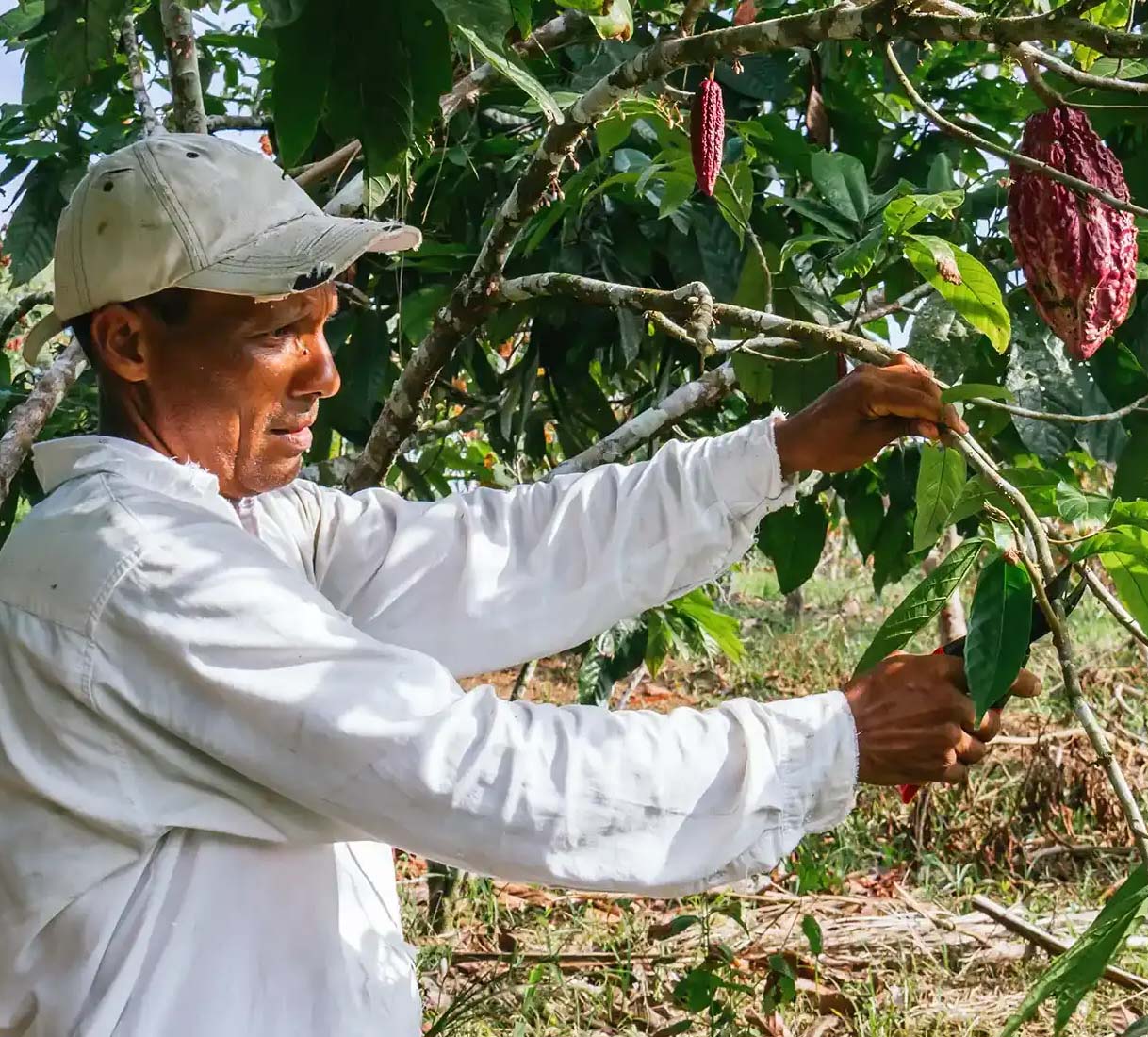
Plantation Worker tending to a Criollo Cacao Tree.
“This is one of the disadvantages of wine: it makes a man mistake words for thoughts.” — Samuel Johnson, 1778
How Cacao Genetics Shaped the Craft Chocolate Industry
To understand the flavour of dark chocolate, you have to understand where it begins — not in the factory, but in the field, and specifically in the genetics of the tree.
There are three traditionally recognised varieties of cocoa tree, and therefore three main types of cocoa bean which are used in chocolate making: Criollo, Forastero, and Trinitario. Each produces a meaningfully different flavour profile when made into single-origin dark chocolate. Three varieties, three broad flavours. This is the simple understanding that the industry worked on for decades.
Criollo, Forastero, and Trinitario
Criollo is the oldest cultivated variety — this is the cacao variety the Maya and Aztecs grew, and with their growing Empire carried it into Central America, with centuries of careful selection. The beans are pale, low in tannins, and produce chocolate of exceptional aromatic complexity. Delicate fruit notes, subtle spice, a long finish. It is also fragile. Criollo trees are vulnerable to disease and produce modest yields. Fine flavour comes at a cost.
Forastero is the opposite in almost every respect. Hardy, high-yielding, resistant to disease. Exported to Africa it dominates global cacao production — roughly eighty to ninety percent of the world’s supply. The flavour is robust and direct. Strong cocoa character, sometimes with a pronounced bitterness, limited complexity. It is the variety that built the commercial chocolate industry.
Trinitario came about after a disease event in 1727 — documented in the historical record as “The Blast”. The disease devastated the Criollo plantations of Trinidad. Planters brought in new Forastero trees, most likely from the Orinoco region, and replanted Forastero between the surviving Criollo trees. Natural cross hybridisation followed.
The result was a new variety that carried something of Criollo’s flavour complexity and something of Forastero’s resilience. It was more productive than Criollo. It tasted better than Forastero. Planters selected the best of what emerged. Trinitario spread from Trinidad across the cacao-growing world.
Criollo and Trinitario varieties are the basis of most fine-flavour chocolate today — including cacao from Madagascar and Trinidad, two of MayHawk’s single-origin sourcing regions.
The Motamayor Research — A New Map of Cacao Genetics
However, in 2008, researcher Juan Carlos Motamayor and his team mapped the genetic diversity of South American cacao with greater precision than had previously been attempted. They identified not three varieties, but ten distinct genetic clusters: Amelonado, Contamana, Curaray, Criollo, Iquitos, Marañon, Nacional, Nanay, Purús, and Guiana. Subsequent peer-reviewed research has since identified an eleventh cluster — Caquetá, located in Colombia — refining the map further.
The long-standing catch-all term “Forastero” — which had covered the majority of the world’s cacao supply — was revealed to be a broad grouping rather than a single coherent variety. Useful shorthand, but not botanical precision. Importantly, within the forastero variety, was found to be a rich and diverse selection of cacao with fine flavour potential.
African Cacao
African cacao, introduced from South America during the colonial period, sits largely within the Forastero grouping — particularly Amelonado. There are exceptions. Fine-flavour cacao does exist on the continent, and the full picture is more nuanced.
Yet, what has shaped African cacao’s reputation and flavour for generations is that growers historically prioritised yield, disease resistance, and agricultural resilience over fine-flavour complexity. When a variety is bred for volume rather than character, and harvested under conditions that prioritise speed over precision, the bean’s potential — whatever it might have been — is systematically reduced before it reaches the factory.
The Economics of Origin
The Motamayor research in 2008 gave the craft chocolate industry something it had been quietly seeking — a vocabulary of connoisseurship. Chocolate could now be discussed as wine is discussed: varietal purity, provenance, the specific character of named growing regions. Origin could be premiumised. The language of the sommelier had arrived in the chocolate aisle.
This created both a commercial opportunity and a beneficial consequence worth understanding.
As demand for named, traceable, high-quality cacao has grown, competition for the best beans has increased prices at source. Chocolate made from fine flavour cacao sells within the craft sector at much higher prices than a commercially made chocolate bar. Therefore, farmers, cooperatives, and growers in origin countries — Ecuador, Peru, Madagascar, Tanzania etc. — are seeing a better income for better beans.
Their efforts are being rewarded and their livelihoods improved. Environmental initiatives are being rolled out, protecting the natural resources. This virtuous cycle is being created through improved returns and new investment.
After decades in which industrial chocolate production depressed prices across the supply chain, the economics of premiumisation are producing a measurable improvement in grower livelihoods. That is not a minor development. It is one of the more substantive arguments for what the craft sector is building. At MayHawk, every bar is created around named, single-origin cacao — selected for the character of its growing conditions.
Mistaking words for thoughts
While premiumisation has given the craft sector a new vocabulary, at MayHawk our advice is to be careful swinging that axe. This new vocabulary could start to create barriers — replacing accessible, emotional descriptions with elitism. The casual consumer could start to feel alienated, making craft chocolate feel like a test of intellect rather than an enjoyable experience.
What the craft sector needs is the language of inclusion — because there is a fine line between knowledge and performance.
The genetics are real. The flavour differences are real. The environmental argument for origin-focused sourcing is real. The supply chain benefits are real. How the craft sector decides to educate around this, is a choice that needs careful consideration.
TLDR: Cacao genetics are not a marketing construct. Criollo, Forastero, Trinitario — and the genetic clusters the 2008 Motamayor research identified beneath them — produce meaningfully different flavour potential. Premiumisation built on that science has improved grower returns across the supply chain. The vocabulary it created is genuine. What people do with that vocabulary is another matter entirely.
Conner. 26th May 2026.
Conner. Copyright MayHawk.
All rights reserved. No part of this publication may be reproduced, distributed, or transmitted in any form without prior written permission.