MayHawk Insights 07
Milk Chocolate — The Legal Definition, the Drift, and What Was Lost
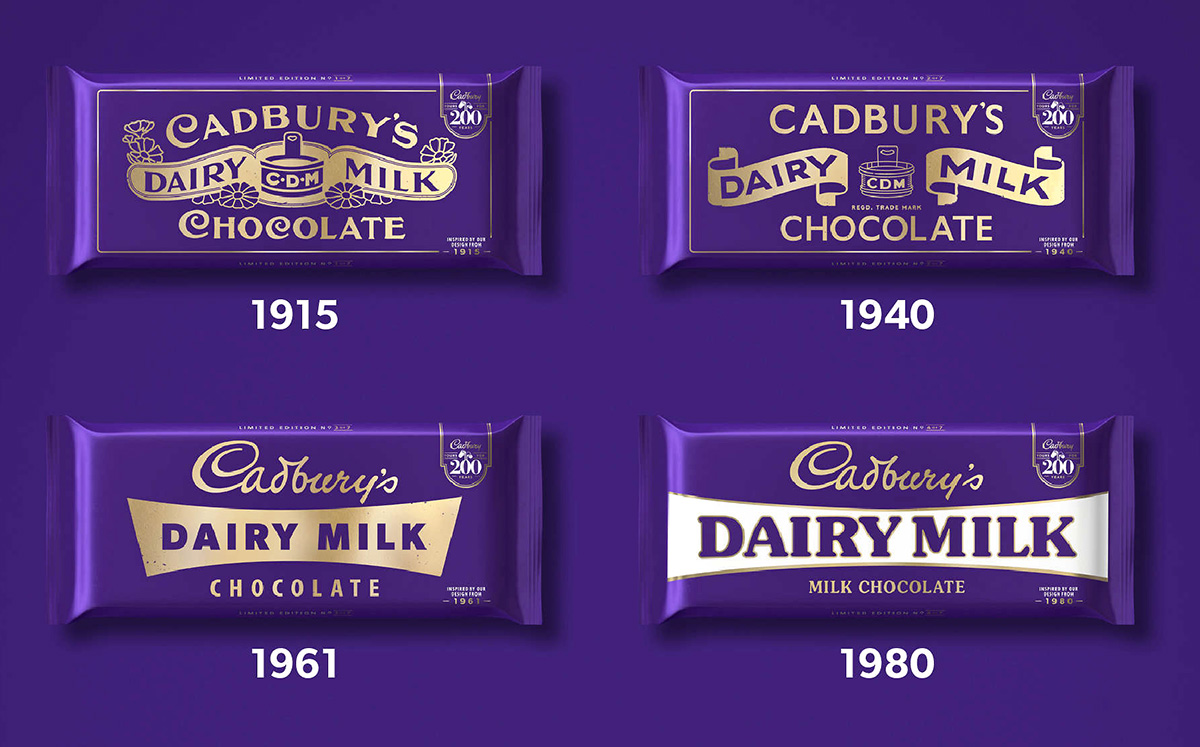
Cadbury’s Dairy Milk Wrapper Designs 1915 to 1980.
“A great civilisation is not conquered from without until it has destroyed itself from within.” — Will & Ariel Durant
Like the gradual erosion of an Empire, the decline of milk chocolate was not caused by a single decision. It happened through two parallel processes: less cacao, and less craft. Both were driven by the same economic pressure, producing more for less, and increasing profits.
The 25% Rule
Most people assume that if a company calls something milk chocolate, then it must be milk chocolate.
In Europe that is no longer the case. Under EU Directive 2000/36/EC, published in June 2000, it stated a legal definition. Milk chocolate must contain a minimum of 25% cocoa solids. Below that threshold, it cannot legally be sold as milk chocolate across Europe (with two exemptions). The directive established a formal legal definition of what milk chocolate is and, importantly, what it is not.
The directive did not suddenly appear as bureaucratic interference. By the late twentieth century economic pressures and the need for continued growth had encouraged manufacturers to reduce expensive cocoa ingredients wherever possible. More sugar, less cocoa — using alternative vegetable fats in place of cocoa butter. Each change was rationalised at board level, each one improved margins, with company net profits increasing year on year. Yet each alternative ingredient moved the category of chocolate a little further from its origins as the traditional list of ingredients was being replaced.
This was the slow erosion of past standards. And milk chocolate suffered more than most.
Consumers still saw familiar brands and familiar wrappers, but the composition inside them had changed. The category had drifted far enough that EU politicians, under direction from lobbying camps, had decided a common legal definition was now needed. For the first time, there was a legally enforceable distinction between milk chocolate and products that no longer met the standard.
Since 2000, products sold across most of Europe falling below the 25% threshold could no longer be sold as milk chocolate under the directive’s classification rules. Instead, they had to be reclassified as “family milk chocolate.” Not a flattering name. Not a commercially attractive one either.
The significance of the directive was not that it changed milk chocolate. The category had already changed. What the directive changed was the definition.
For the first time, there was a legal line between milk chocolate and something claiming to be it.
A Derogation Thirty Years in the Making
Is it illegal to call a chocolate bar containing less than 25% cocoa solids “milk chocolate” in Europe? Yes, in principle.
Under Directive 2000/36/EC, only the United Kingdom and Ireland were granted a derogation, retaining the right to label products containing a minimum of 20% cocoa solids as milk chocolate. A derogation is a formal legal exemption that allows a specific rule or obligation not to apply.
This is the part of the story that is often misunderstood. The derogation was not a concession won during the negotiations surrounding the 2000 directive. It was the continuation of an arrangement already in place since 1973, when the UK and Ireland joined the European Community.
Both countries entered with established chocolate industries operating at a lower cocoa solids threshold and using vegetable fats in chocolate manufacture. Rather than forcing immediate change, the accession agreements accommodated those existing practices. Nearly thirty years later, Directive 2000/36 simply carried those exemptions forward into a harmonised legal framework.
The significance is straightforward. While most of Europe adopted a minimum cocoa solids threshold of 25% for milk chocolate, Britain retained its long-standing 20% definition.
If products falling below the 25% threshold could not be marketed as milk chocolate across most of Europe, what could they be called? They were classified as “Family Milk Chocolate” — a designation that rarely appeared because few manufacturers wished to market their products under such an uninspiring name. The designation served its purpose. Manufacturers faced a strong commercial incentive to reformulate products rather than adopt the new classification.
The directive, however, was responding to a broader trend than cocoa percentage alone. Across the second half of the twentieth century, many manufacturers had gradually altered their recipes in pursuit of lower production costs and higher margins. Sugar levels increased, cocoa solids declined, cocoa butter was partially replaced with alternative vegetable fats, emulsifiers and e-numbers were needed to stabilise these recipes, while manufacturing processes were simplified to improve efficiency. Individually, each change appeared modest. Collectively, they transformed the character of the category.
The derogation meant that manufacturers in Britain and Ireland faced no such pressure to reformulate. Consider Cadbury Dairy Milk, the best-selling chocolate bar in the United Kingdom. The product declares a minimum cocoa solids content of 20% on its packaging. In Britain, it satisfies the legal definition of milk chocolate. Across most of Europe, it falls below the threshold required for that classification and would instead be considered Family Milk Chocolate.
Yet the Cadbury example also reveals the limits of judging chocolate by percentage alone. The original 1905 Dairy Milk recipe itself was already developed around a cocoa solids content of 20%. What distinguished it was not a higher proportion of cacao, but the quality of its ingredients, its unusually high milk content, and the manufacturing techniques used to create it.
Under European regulation, milk chocolate is defined in part by a minimum dry milk solids content within the finished product (14%). Most mass-market European milk chocolates treat milk as a balancing ingredient — present to soften cocoa intensity and stabilise sweetness, but not the defining character of the product.
Cadbury Dairy Milk was built around a different proposition to the European ideals. From its original 1905 formulation, milk was treated as a primary ingredient rather than a supporting one (23%). That balance between milk presence and cocoa structure is what defined the early product’s character. It is also what made it historically distinct and commercially popular.
The real story of decline lies elsewhere.
The derogation therefore preserved Britain’s traditional definition of milk chocolate. Whether that definition represented a lower standard is a more complicated question. Cadbury’s had kept the 1905 20% cocoa solids as a baseline, but they had replaced cocoa butter with vegetable fats, needing emulsifiers to bind it, and they had changed their traditional manufacturing processes through modernisation.
The Industrial Benchmarks
Modern Gold Standard Milk Chocolate
If we are to name the industrial gold standard for milk chocolate, it is Valrhona’s Jivara — developed in 1995, with 40% cocoa solids minimum, and a flavour that earns its reputation amongst the best chocolatiers. It strikes a delicate balance between a deep, chocolatey foundation and sweet, mellow undertones of vanilla and malt. In setting a new benchmark for what milk chocolate could be, it demonstrated that creaminess and genuine cacao character were not in opposition.
At 40% cocoa solids, Jivara sits exactly double the UK legal minimum. The malt and caramel notes that define it are a direct consequence of that higher ratio. At 20% cocoa solids, those notes have nothing to build from. Sweetness predominates at low cacao percentages — and too much vegetable fat and the melt does not leave a clean mouth feel.
What Early Cadbury’s Milk Chocolate Was Like
Modern Cadbury Dairy Milk bears only a passing resemblance to the chocolate launched in June 1905. The original was revolutionary for its unprecedented proportion of fresh, liquid full-cream milk. It was developed by George Cadbury Jr. to compete with superior Swiss chocolates, which relied upon condensed milk powder.
The original 1905 recipe was a remarkably simple product. Fresh full-cream milk, sugar, cocoa mass, cocoa butter, and natural vanilla extract formed the foundation of the chocolate, with no emulsifiers or added vegetable fats. The manufacturing process relied on slow cooking and careful mechanical refinement rather than chemical aids. The flavour profile was astonishingly good for a bar of this period.
The Lost Art of Crumbing
In the original Cadbury Dairy Milk recipe of 1905 the ingredients mattered, but the manufacturing process mattered just as much.
One of the most important techniques was known as crumbing.
Crumbing begins before any cacao is introduced. Fresh milk and sugar are combined and subjected to a carefully controlled thermal process. Under gentle heat and over an extended period of time, the milk proteins and sugars undergo the Maillard reaction — the same family of reactions responsible for the browning of bread, roasted coffee, and the surface of a crème brûlée.
The result is not simply a sweeter ingredient. It is a more complex one. Notes of caramel, malt and cooked cream are developed directly within the milk base itself before it ever becomes chocolate.
This is where the story of decline is found. Modern mass-market production replaced this with high-temperature flash-drying. Faster, cheaper, and capable of producing something that resembles the result from a distance.
The erosion of standards was not only visible in the recipe. It was visible in the factory. What changed was not only what chocolate was made from, but how it was made.
MayHawk and the Milk Chocolate Question
We developed our own milk chocolate (and separately a darksome milk chocolate) not by asking how sweet a traditional milk chocolate can be made, but how much genuine cocoa character it can carry while still remaining unmistakably milk chocolate. At around 40% cocoa solids, with higher milk solids and lower sugar, the answer appears to be: considerably more than the category had historically assumed. So, this is what we worked on.
If Jivara demonstrates what happens when cocoa presence is allowed to remain structurally visible, and early Cadbury shows what happens when milk is treated as a site of flavour development — then the most significant differences in milk chocolate are not explained by cocoa percentage alone. They are also explained by how milk is treated, how sugars are developed, and how much of the flavour is created before the chocolate is fully formed.
It is this line of inquiry that shaped our own Milk Chocolate — an exploration of what happens when those earlier principles are taken seriously again under modern conditions. Milk chocolate is often relegated to an afterthought by the craft chocolate sector. In our Chocolate Studio, it is not.
What we call milk chocolate has always been less a fixed category than a record of how each generation chose to balance cost, craft, and taste — a set of choices made visible at different points in time.
TLDR: Jivara is great. We’re better. Cadbury’s used to be the best.
Conner. 16th June 2026.
Conner. Copyright MayHawk.
All rights reserved. No part of this publication may be reproduced, distributed, or transmitted in any form without prior written permission.