MayHawk Insights 08
Vanilla — What It Is, What It Isn’t, and What It Should Never Have Been
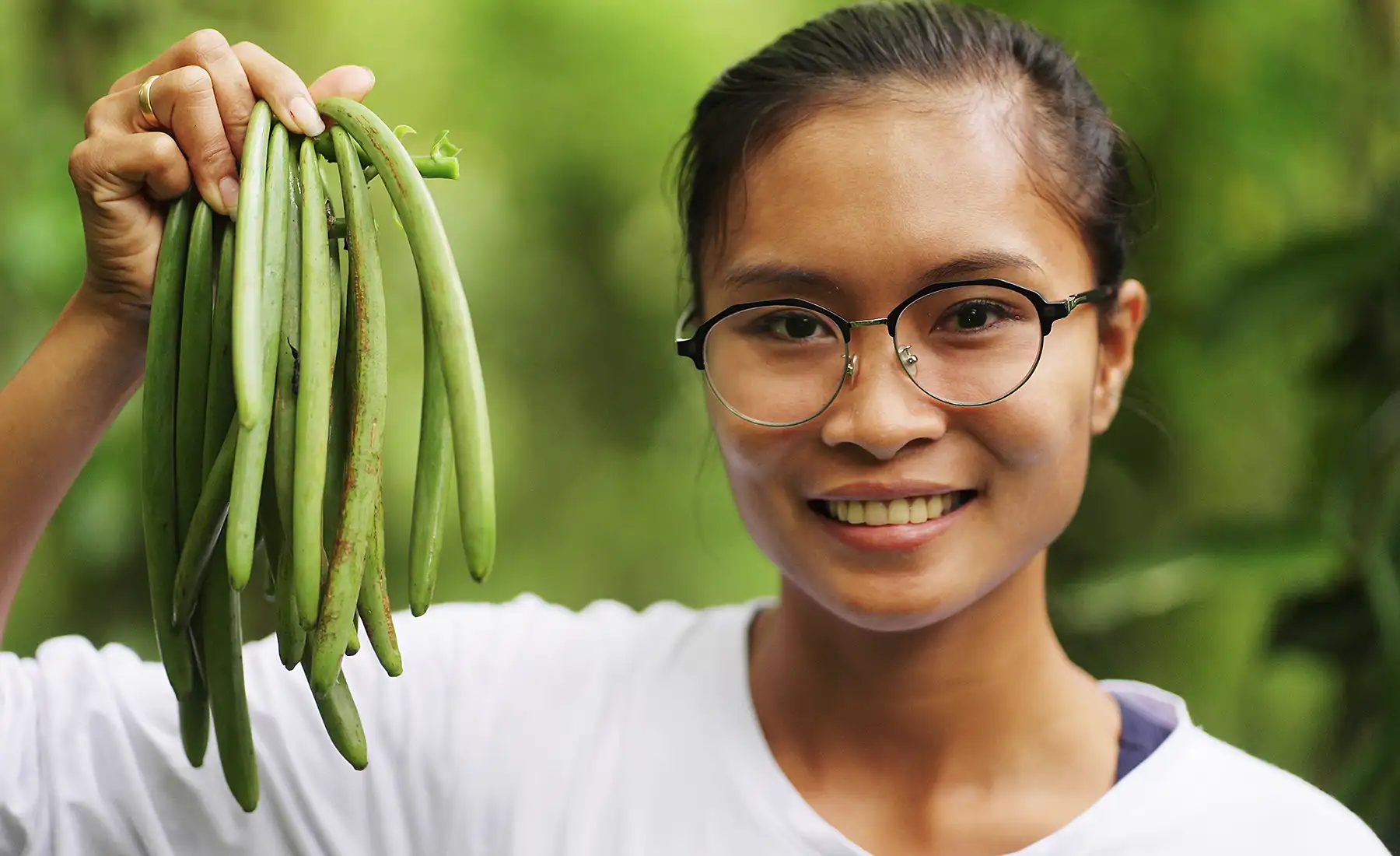
Vanilla Plantation. Plantation worker holding harvested vanilla pods.
“If names be not correct, language is not in accordance with the truth of things.” — Confucius, The Analects
Chocolate and vanilla’s relationship is misunderstood in the modern craft chocolate space. The all-or-nothing debate is giving the wrong answer to the wrong question. Another question: Which of the vanillas do you use? Is also frequent. That has a more straightforward answer. Vanilla.
The Orchid Before the Flavour
As a member of the Orchidaceae family, the genus Vanilla contains approximately 110 species distributed across the tropical regions of the globe. Three of those species dominate commercial production.
Vanilla planifolia, native to Mexico and Central America, accounts for the majority of the world’s supply and is the source of the profile most consumers recognise. Also grown on the islands of the Indian Ocean — Madagascar, Réunion, and the Comoros — it is known commercially as Bourbon vanilla.
Vanilla tahitensis, grown principally in Tahiti and Papua New Guinea, carries a distinctly floral character.
Vanilla pompona, rarer and increasingly marginal commercially, completes the trio.
Of some 35,000 orchid species in existence, vanilla is the only genus humans cultivate for food. What arrives as an ingredient is a dark, long, supple pod. This is the end point of an agricultural process of considerable complexity — not a product assembled in a facility, but a crop grown from a specific plant in a specific part of the world.
The World’s Most Demanding Spice
Vanilla is the second most expensive spice on earth after saffron. And most people don’t know why. The reason is not scarcity of the plant. It is the nature of the flower.
In 2025, a kilogram of Grade A Madagascan vanilla beans traded at around $250.
The key to unlocking the price — and all the economic decision making that flows from it — is the simple understanding that a vanilla orchid blooms once a year. For one day only.
Each flower opens for a single morning — by afternoon, it has closed. If it has not been pollinated during that window, no pod forms. In its native Mexico, pollination is carried out by native bee species of the Euglossa and Melipona genera. Outside Mexico, those pollinator bees do not exist. Every vanilla pod grown anywhere else in the world — Madagascar, Réunion, Indonesia, Tahiti — has to be pollinated by a human hand.
You Have One Shot at This. And Edmond Knew It.
In 1841, on the island of Réunion, a twelve-year-old enslaved boy named Edmond Albius worked out how to pollinate vanilla by hand using a small stick, lifting the membrane that separates the flower’s male and female organs and pressing them together.
The technique — le geste d’Edmond — takes seconds to perform and is still used today, on every vanilla farm in every producing country outside Mexico. Without it, Madagascar would not exist as the world’s dominant vanilla producer. The modern vanilla industry traces directly to that observation.
The Curing — Where the Flavour Is Actually Made
The green vanilla pods are harvested before maturity. They contain none of the vanilla flavour we are familiar with as they leave the vine. The characteristic profile develops entirely during curing — a process of controlled sweating, drying, and conditioning that takes several months. It is skilled, exacting work carried out by curers.
In Madagascar and across the major producing regions, growing and curing are typically carried out by different hands entirely. The growers tend the vines, manage the pollination, and harvest the pods. The curers take over from there — monitoring temperature, managing moisture, turning and conditioning the pods through each stage of the process. Both roles demand expertise. Neither can compensate for a failure in the other.
In this respect vanilla is structurally similar to cacao. Both need extra steps to become the product we know. Both natural ingredients develop their defining flavour through post-harvest process, not through the plant itself. Both reward the patience and skill of multiple pairs of hands with something that cannot be hurried into existence.
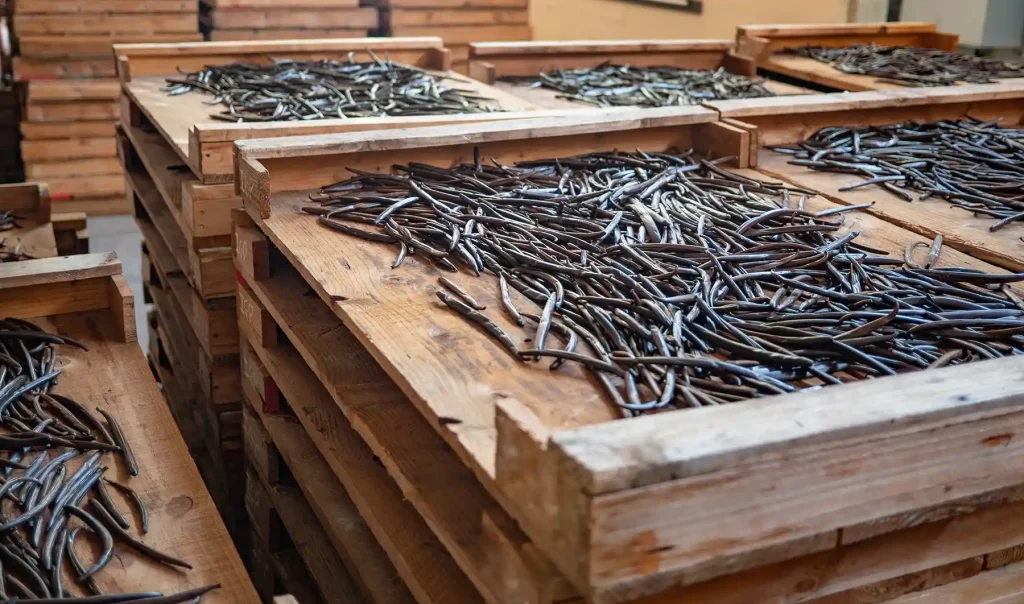
Cured Vanilla planifolia pods laid out to dry on wooden trays during the conditioning stage of the vanilla curing process, Madagascar.
A Thousand Years Together
“If cacao was the food of the gods, vanilla was definitely the nectar that accompanied it.” — Patricia Rain
‘Using vanilla to mask poorly made chocolate’. This is a modern statement, and a modern misinterpretation of what vanilla is doing in cacao. It also miscalculates the entire history of these two ingredients, and their very long partnership.
Vanilla and cacao did not meet in a European confectionery recipe, at some point in the Victorian industrial era. They arrived in that era already together, having shared centuries of recorded use.
Although, real vanilla can soften bitterness and mask flaws. That is not the same as saying vanilla is being used to mask them.
The Totonac people of present-day Veracruz, Mexico, were the first to cultivate vanilla, tending the wild orchid vines within their forest gardens long before European contact. When the Aztecs absorbed the Totonac people, they also began to include vanilla, alongside cacao, in xocolatl, the bitter, spiced beverage of Mesoamerican court culture.
Vanilla softens bitterness. Extends aroma. And binds the volatile compounds of roasted cacao into something more coherent.
Hernán Cortés brought both cacao and vanilla back to Spain in the 16th century. They arrived as a pair, not independently, and were adopted by Spanish courts as a pair. Vanilla has always been linked to cacao in Europe. It was not introduced to chocolate as an afterthought. It was there from the beginning.
Craft chocolate can make peace with vanilla. The connection predates the bar by centuries. The question becomes, what are you doing with it?
Why the Pairing Survived
The relationship between vanilla and cacao is not simply cultural habit carried forward by inertia. It is sensory and biochemical.
Real vanilla, after curing, contains more than 200 volatile aromatic compounds. Cacao, after fermentation, drying, and roasting, also contains several hundred. The two profiles occupy overlapping aromatic territory — sharing compound classes across warm, roasted, and phenolic note families.
That overlap is part of what makes them coherent together rather than competing.
Vanilla also performs specific work on cacao’s harder edges. It suppresses the perception of bitterness — an effect traceable to vanilla’s interaction with the polyphenol compounds responsible for cacao’s astringency. It enhances the perception of sweetness without adding sugar.
It provides aromatic cohesion. The transitions between cacao’s front notes and its deeper, slower development are smoothed by vanilla’s presence — perceptible even when vanilla itself is not identifiable as a discrete flavour in the finished chocolate.
The pairing survived for centuries because it works. The science is the explanation for the history, not the other way around.
When Vanilla Became Something Else
“A rose by any other name would smell as sweet” — Shakespeare isn’t commentating on an industrial age, and he didn’t have an orchid in mind. If we believe the beginning of wisdom is to call things by their proper names — then the beginning of industrial reduction is to attach a chemical compound to a proper name. Vanilla. Vanillin. It makes it seem the chemical compound, made in an industrial lab, is something else entirely, a rose by any other name.
The natural vanilla flavour profile is built from more than 200 aromatic compounds. One of them — vanillin, chemically 4-hydroxy-3-methoxybenzaldehyde — is the most dominant, responsible for the note most immediately associated with the ingredient. In 1858, a French scientist named Nicolas-Théodore Gobley isolated vanillin from vanilla pods. By the 1870s, chemists had found a way to synthesise it. Most commercially processed food requiring vanilla, and a lot of cheap chocolate, now uses this synthetic version.
But vanillin is not vanilla. It is one compound extracted from one component of a profile containing hundreds. What it shares with vanilla is a single dominant aromatic note. What it lacks is everything else — the supporting compounds, the complexity of development, the aromatic behaviour that changes across time and temperature. One is made in nature, the other in a lab.
Most commercial vanillin today is produced industrially: from guaiacol, a petrochemical derivative; from lignin, a byproduct of wood pulp processing; from ferulic acid derived from rice bran. It is cheap, stable, and consistent.
In 2025, a kilogram of Grade A Madagascan vanilla beans traded at around $250. One kilogram of synthetic vanillin concentrate costs roughly $12.
The Hierarchy of a Price Point Matters
Vanilla beans carry the full profile. Vanilla extract, made by macerating beans in alcohol, retains most of it. Vanilla paste and powder retain it in varying concentrations depending on the production method. But these use cheaper grade, or even already processed vanilla beans. Vanillin — whether naturally isolated or synthetically produced — carries one molecule from one compound class.
When people argue that vanilla in chocolate is used to mask poor quality, they are rarely describing vanilla. The highest grade vanilla beans — the second most expensive spice in the world — are not being used as a masking agent. People are describing an industrial flavour system built around a reduction of costs, right down to synthetic vanillin. The cheaper the vanilla derivative, the more often it is used at concentrations designed to overwhelm rather than complement — used to substitute (and mask) the quality of the poorest commercial chocolate.
That is a legitimate critique of a legitimate practice. In the ingredient list, if the chocolate uses vanilla extract or especially vanillin, eyebrows should be raised. But the ingredient being criticised is often not vanilla. It borrowed vanilla’s name and inherited its cultural standing. The orchid had nothing to do with it. The hard work of the vanilla plantation workers and curers had nothing to do with it.
What It Should Never Have Been
Where is the truth to be found, if not in its name? “If names be not correct, language is not in accordance with the truth of things.” — Confucius, The Analects
Vanilla now describes something as ordinary. Basic. Without distinction.
The phrase ‘plain-vanilla’ entered commercial language to describe the simplest, most default version of something — a plain-vanilla finance quote, a plain-vanilla software package, that person is plain, like vanilla. The vanilla option. It is used, without irony, to describe the unremarkable. When it is remarkable in so many ways.
Historically, vanilla was rare, globally traded, and highly valued precisely because it was not easily obtained. An ingredient cultivated by hand, pollinated flower by flower in the brief window of a single morning, cured over months through careful controlled process. Then a laboratory worked out how to synthesise and mass produce vanillin. The rest is modern history — now, as an ingredient, vanilla is used with suspicion and confusion — reduced in the common language to a synonym for the ordinary.
The word has lost its true value. And this should never have been.
Using Vanilla at MayHawk
We don’t use vanilla in most of our chocolate — if we do, we of course mean real vanilla, Madagascan vanilla planifolia (Bourbon) beans and the 200 aromatic compounds it carries. The position that it should never be present in chocolate is not especially interesting. Neither is the position that it should always be.
The more considered question, is whether vanilla genuinely contributes something to a specific chocolate.
Chemistry is another misunderstood word. It has taken on a meaning of ‘making something artificial’, particularly in the food industry. Chemistry is the scientific study of matter — what it is made of, its properties, and how it behaves and changes. Understanding the chemistry of a natural ingredient used in chocolate is to understand the role it plays — for instance, at MayHawk we look at the underlying chemistry of what each ingredient undergoes in the process of fermentation.
Does This Added Layer Make a Positive Contribution
Every ingredient in our chocolate is examined in the same way. Both process and method play a part in the development, and each ingredient has to earn its place. With our 75% Espresso Chocolate, the addition of vanilla was thought out and considered.
Five ingredients: cacao beans, cane sugar, cocoa butter, coffee beans, vanilla beans. The vanilla is not present to make the chocolate taste of vanilla. It is present because cacao, coffee, and vanilla occupy an overlapping aromatic territory — sharing volatile compound classes across roasted, phenolic, and warm note families — and because vanilla performs specific work on the bitterness that high-roast coffee introduces into dark chocolate.
The chemistry called for it. The recipe followed.
Perhaps the greatest misunderstanding of vanilla isn’t if it belongs in chocolate or not, but that we forgot why it was there in the first place.
TLDR: Vanilla is one of the most complex agricultural ingredients in food — an orchid, hand-pollinated flower by flower, its flavour built entirely through months of post-harvest curing. Its relationship with cacao is not modern. It is a thousand years old and biochemically founded. What is used to mask poor chocolate is not vanilla. It is often synthetic vanillin: one molecule, industrially produced, wearing a borrowed name. The two things are not the same ingredient.
Conner. 23rd June 2026.
Conner. Copyright MayHawk.
All rights reserved. No part of this publication may be reproduced, distributed, or transmitted in any form without prior written permission.