MayHawk Insights 09
The Ghost in the Machine
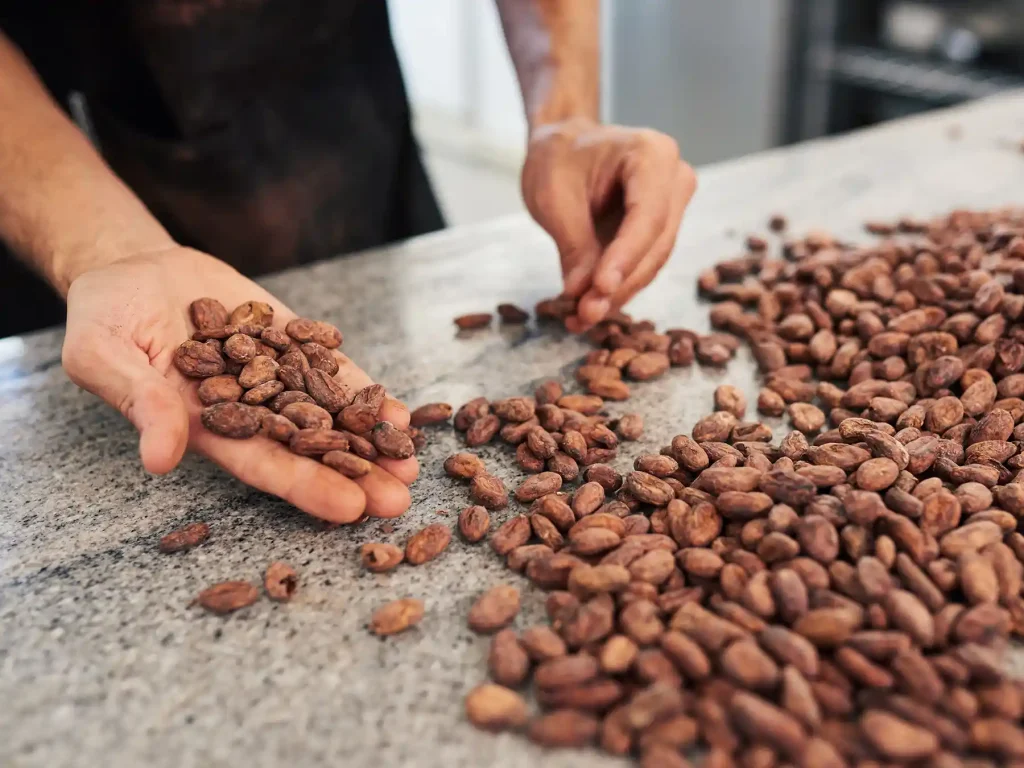
Hand-sorting cocoa beans at The Studio
“Give me a place to stand, and a lever long enough, and I will move the world.” — Archimedes
Chocolate is not just a reflection of the machine used to make it. It is a reflection of the machine and the human decision-making behind it.
The spirit and ethos behind the tools matter. The ingredients matter. What is left out and what is added matters. But none of that changes a simpler truth: better machinery makes better chocolate possible. Not inevitable. Possible.
The Equipment Argument
Precision is not a luxury in chocolate making. It is the difference between a flavour that arrives, stays in the melt, intrigues, and finishes with a clean note — and one that doesn’t.
Consider the roaster. Cacao beans carry their flavour potential as precursors — compounds developed during fermentation that require heat to complete their transformation. The roasting stage is where that transformation happens, and the window is narrow.
The roasting profiles of cacao are almost the reverse of coffee roasting. Coffee beans are typically roasted at high temperatures for a relatively short time — developing their characteristic profile through rapid, intense heat. Cacao requires the opposite: lower temperatures, longer durations, and careful control of both. The volatile aromatics in the cocoa beans that carry the finest notes — the fruit, the floral, the acidity — are driven off by excessive heat before they ever reach the finished chocolate. Yet, the best roasters for cacao are commercial-grade coffee roasters, running at different settings entirely. The same machine. Completely different chemistry.
Precise temperature control and even airflow of these roasters give the maker the ability to work within that window deliberately, adjusting for bean origin, moisture content, and fermentation profile. A domestic oven gives the maker approximate heat and hope.
The grinder follows the same logic. Particle size in chocolate is not simply a textural question — it is a flavour question. A grinder takes the solid ingredients and, under friction and heat, reduces the chocolate to a liquid as the cocoa butter melts, while the ingredient particle size is reduced over time. Particles above 30 microns are perceptible on the tongue as grittiness. Below 20 microns the chocolate becomes paste-like, losing definition. Between them is where texture and flavour clarity live together. A precision grinder holds that window consistently across a batch. A basic melanger drifts through it unpredictably, and the maker compensates by feel rather than by measurement.
The conche is where the argument becomes most visible. Conching develops flavour through controlled agitation and aeration over time — driving off unwanted volatile acids, developing aromatic complexity, and refining the texture of the final chocolate. A well-engineered conche gives the maker independent control over temperature, duration, and airflow. The result is a chocolate where each variable has been considered separately. A basic conche conflates those variables — and in much of the craft sector, there is no conche at all. The maker gets one dial where three are needed.
This is the truth of the matter. Better machinery does not make decisions. It makes the consequences of decisions visible. When the tools are imprecise, the maker cannot know whether a flavour outcome is the result of their choices or the limitations of their equipment. Precision removes that uncertainty. The ghost in the machine is the craft chocolate maker — and with better machinery, the maker finally has a true voice.
Scale and Soul Are Not Opposites
At maximum production, over 500,000 iPhones are made every day. Yet each one still feels personal to the person who opens the box. The fit and finish of each one is extraordinary.
That is not a coincidence of marketing. It is the consequence of decisions made long before the assembly line starts — decisions about material, proportion, tolerance, and finish that are designed to produce a specific experience at scale. The scale does not dilute the intent. It delivers it, consistently, to more people.
The same principle applies to chocolate. Soulless chocolate is not created by the machinery. It is created long before the machinery is switched on — through layers of financial decision-making driven by accountants, executives, and shareholders whose primary question is not what this chocolate can become, but what it can be reduced to while remaining sellable. The machinery executes those decisions faithfully. A precise conche in the service of a compromised recipe produces a chocolate with a precise compromise.
Million-pound commercial machines do not make chocolate soulless. They provide a clinical, precise canvas for the ingredients and philosophy of the maker to truly shine. The question is always what the maker brings to that canvas — and whether the decisions made upstream of the machine are worth executing at all.
At MayHawk our goal is simple: to take the same garage-born ethos and graduate it to the finest tools in the world. The spirit does not change when the equipment improves. It becomes more fully itself.
The Romanticism of Struggle
There is an ongoing narrative by some craft chocolate makers that romanticises basic domestic machinery — as though struggle itself somehow improves flavour. As though the limitation is the point.
It is not.
This is a modern invention, not a craft tradition. William Morris — whose thinking sits at the foundation of everything the craft movement values — did not romanticise inadequate tools. He believed in the dignity of skilled work and the integrity of materials. He also ran a successful commercial operation with proper equipment, under skilled men and women, because he understood that the work required the right tools to reach the people it was made for at a larger scale. This was art and beauty, correctly mass-produced and democratised, in a new industrial age.
The best independent software developers do not write code on inferior machines to demonstrate authenticity. A surgeon does not operate with a blunt instrument to prove commitment to the patient. The tool serves the vision. The vision is not the tool. So. Give me a sharp scalpel.
Settling for basic machinery does not make chocolate taste better. It does not make it more authentic. What it does is introduce a ceiling — a point beyond which the maker’s skill and intention cannot travel, not because of any failure of craft, but because the equipment cannot follow. The flavour that could have existed never arrives. The people supporting the maker — often because they understood the trade-offs from the beginning — deserve better than a ceiling that was chosen rather than imposed.
Struggle is not a flavour note. It is an obstacle to one.
The Outer Boundary
There is a point at which the machinery argument reaches its own limit. And that limit is both instructive and timely.
Lab-grown chocolate — produced in a bioreactor from isolated flavour compounds and genetically coded sequences rather than fermented beans — is not a distant or theoretical proposition. It is being actively developed, and it is soon to become a commercial reality. The subject is new enough that the industry is only beginning to grapple with what it means. But the questions it raises are already the most interesting ones in chocolate production.
On one reading, it is simply the machinery argument taken to its logical conclusion. If better equipment produces better chocolate, and better still produces better still, where does that lead? The bioreactor is the answer the efficiency argument eventually reaches — no farms, no fermentation, no harvest, no specific tree in a specific valley tended by specific hands over decades. Just the compounds, reliably produced, at scale.
And here is where the machinery argument exposes its own fallacy. The bioreactor can replicate a flavour profile. It cannot replicate provenance. It cannot replicate the local fermentation processes. The character of a Madagascan Trinitario or a Peruvian Nacional is not a genetic sequence — it is the accumulated consequence of soil, altitude, rainfall, fermentation, and the decisions of the people who grew and processed it. That is not replicable in a laboratory because it is not, at its core, a chemical problem. It is a place problem. A people problem. A time problem.
Better machinery serves the ingredient. The bioreactor replaces it. These are not points on the same continuum. They are different arguments about what chocolate is — and what we believe it should remain.
The Place to Stand
At MayHawk, the question has never been whether to improve the tools. It has been how to ensure that what improves is the chocolate, not merely the efficiency of producing it.
In 2007, the domestic machinery and the tools we built set a ceiling on what was possible. The ethos, the ingredients, the decision-making — those were never the limitation. The tools were. Every improvement since has been an attempt to close the gap between what the chocolate could be and what the equipment allowed it to become.
Archimedes understood that the lever does not move the world by itself. You need the place to stand. At MayHawk, the place to stand is the philosophy — the ingredients, the origins, the decisions made before the machines are switched on. The ghost in the machine.
While we look for a place to stand, and a long enough lever, thank you for supporting us.
TLDR: Better machinery gives craft its truest voice. Soulless chocolate is a financial decision, not a mechanical one. And lab-grown chocolate in a bioreactor is not a better lever — it’s moving a different world entirely.
Conner. 30th June 2026.
Conner. Copyright MayHawk.
All rights reserved. No part of this publication may be reproduced, distributed, or transmitted in any form without prior written permission.