MayHawk Insights 11
Tempering Chocolate — Part Two: The Practice
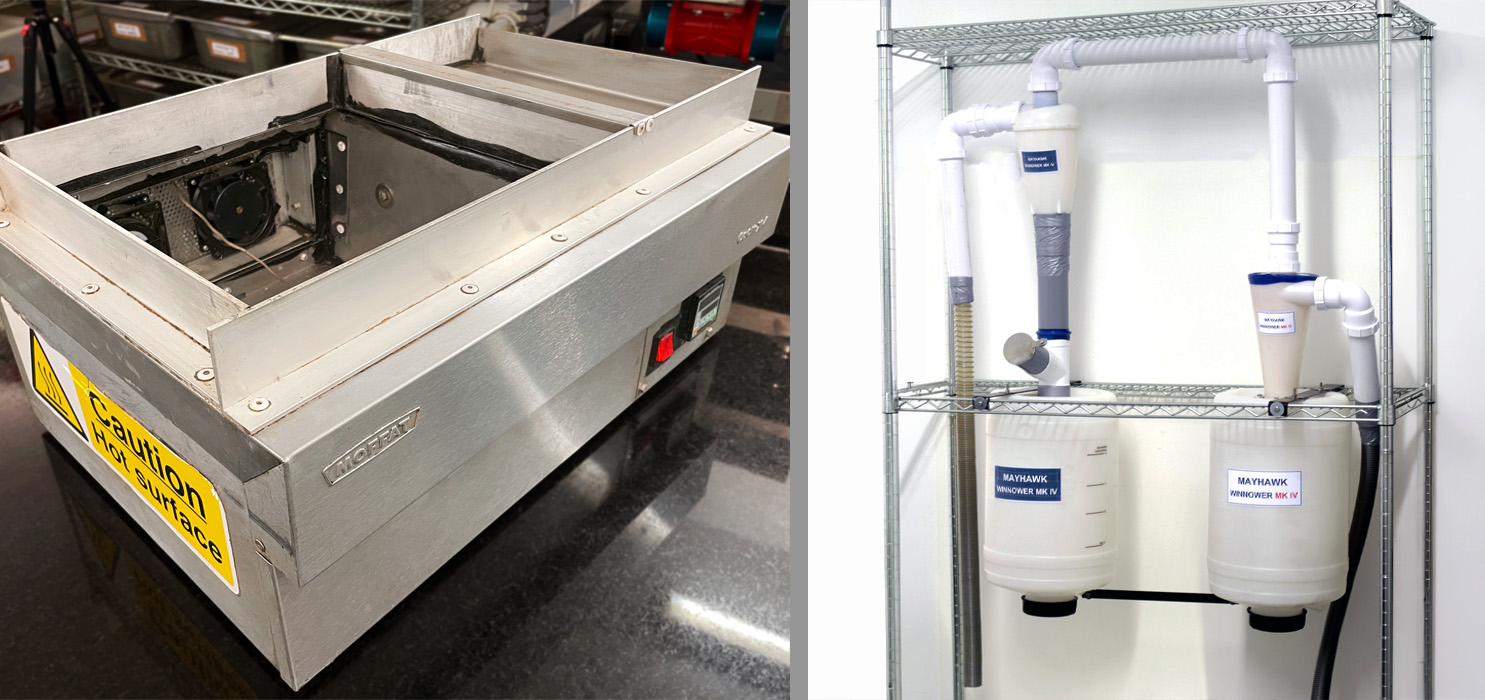
Just two of the machines we built in the early years. On the left is a holding tank we built, controlled by a PID wired up to fans and a heating element that we installed (long retired and pulled out of storage to photograph). On the right is an early version of the ‘winnower’ we built to separate out the husk of the bean from the cocoa nib – powered by a ‘Henry’ hoover (circa 2010). This was the type of invention coming from reading many of the early blog posts in 2005-09 on chocolate making forums, and the things we figured out ourselves. The granite slab the holding tank sits on was the very first one we bought to hand-temper on – it is still in use.
“Invention, it must be humbly admitted, does not consist in creating out of void, but out of chaos” — Mary Shelley, Introduction to Frankenstein, 1831.
Part One (found here) of this Insight covered the science of chocolate tempering in full — the six crystal forms of cocoa butter, why Form V is the only one worth having, and the precise temperature curve that gets you there. None of that explains how a new chocolate maker in 2007, with a startup budget of £1,100 for the tempering of the chocolate, actually achieves it commercially. That story starts with a spreadsheet.
The Finance Question
The first time tempering came up as a problem to solve for MayHawk, it wasn’t a chocolate question. It was a finance question. A budget constraint. This was in 2007.
Starting a bean-to-bar chocolate company is slightly different from starting a chocolaterie — a chocolatier makes chocolate products from bought-in couverture, which is a chocolate made by someone else and sold through wholesale distribution. A bean-to-bar maker and a chocolatier face very different financial propositions as a new company, even though both end up with a finished chocolate product in someone’s hand.
The main concern of a chocolatier, after buying couverture from someone else, is how it needs to be melted, tempered, and moulded. Almost the entire equipment budget of a start-up can go toward doing that one job exceptionally well. A bean-to-bar maker is not so fortunate. They have to budget to do everything — sourcing, sorting, roasting, winnowing, grinding, conching, tempering, moulding and packing — as a startup the budget for each process has to be carved out of the same finite pot. Tempering doesn’t get the lion’s share. As a start-up, it gets a share.
For context, bean-to-bar chocolate was a movement that started roughly in 2005, mainly in the USA, with the UK following shortly after. It wasn’t the small industry sector that it is today, it was a tiny disruptor riding the mood of the buying public looking for chocolate that wasn’t ‘industrial’. It was started by enthusiasts and hobbyists building and making equipment to make small batches of chocolate, using minimal natural ingredients. Back then, when we thought about making chocolate full time, MayHawk’s tempering budget came up for review.
We had already planned to make or renew some of the machines we needed, like the cocoa bean cracker and a basic but serviceable winnower ourselves. And we had the plans to make four single-phase 3HP stone-grinders (all improvements to the smaller machine we had already made). But the obvious answer to tempering was buying a commercial tempering machine — and the obvious benchmark, then as now, was Selmi. So we looked at something along the lines of a 60kg continuous tempering machine. Today, that same equivalent model from Selmi runs to around £24,000.
Back in 2007, the commercial tempering machines were less refined, but the economics were the same: it was a serious capital outlay. However, the outlay was justified by what seemed to be a serious throughput of chocolate making. There were other manufacturers of tempering machines, slightly cheaper, like KeyChoc, a UK firm who had just started making their own machines, but back then there wasn’t the abundance of cheaper or secondhand machinery the craft industry has today. We were looking at paying close to full price, and we didn’t really have £20,000 to buy a Selmi, unless we wanted to pivot into starting up a chocolate shop using wholesale couverture instead of making our own chocolate.
What the Manufacturers Don’t Tell You
Rushing in sometimes works out. But in finances you have to be clear. When we looked deeper into the actual workflow of using these machines, we realised the claims of the glossy brochure didn’t really add up.
60kg is a lot of continuous chocolate tempering. But for £20,000? Was it worth it?
This is what the tempering machine manufacturers don’t tell you. A continuous tempering machine moves chocolate through pipework, pumps, and an internal screw (or, if you’re looking at a smaller 15kg machine, a trough with a revolving polycarbonate wheel and various add-ons) — and every one of those components has to be cleaned thoroughly before a different type of chocolate goes through it. Newer machines have tried to solve this, by improving the clean down procedures, but they still need a complete strip down and cleaning of specific parts.
A plain 65% dark chocolate can usually run after a batch of plain 80% dark chocolate. But milk chocolate cannot go into a machine that just ran a flavoured dark chocolate like coffee without a full clean — and dark cannot go into the tempering machine straight after milk because of the very real allergen risk. And adding in a smooth-ground nut chocolate carries even greater risks.
Note: tempering, grinding, and conching machines all need clean-outs if the change in chocolate type necessitates it — but tempering machines are often the most expensive to double up on, while grinding machines are the real bottleneck. These are all budget considerations for start-ups.
Every changeover on a tempering machine is a stop. Every stop costs time the machine isn’t tempering anything at all. Every clean-out runs the risk of contamination — not just from the previous chocolate, but from the cleaning fluids themselves. Every clean-out, repeated often, is a drag on the operational willpower of the person doing it — a real and constant cost that any new bean-to-bar maker has to weigh before committing to a machine.
And a quick glance at the specs and you realise that the throughput figures these manufacturers claim are at optimal efficiency — it is like saying the costs of driving your car is based on always having only one person in the car, with a full tank, and driving everywhere at 53 MPH. Optimal is what the machine can temper when left alone, without any changes, with already melted chocolate in reserve and a batch of seed chocolate on hand. Optimal is not real world application.
Why So Much of the Craft Chocolate Sector Looks the Same
This is, in fact, why the range of chocolate bars from many small-batch craft makers all look very similar. The smallest craft makers might not have the budget to stretch beyond one 15kg tempering machine. So they make an 80% dark through to a 65% dark, all plain, perhaps with different bean origins, which can run in batches one after another, with barely a wipe-down between batches.
The tempering machine has to be cleaned thoroughly before a milk chocolate can go through, if it’s gone through many cycles of dark chocolate and you want to keep everything ‘single-origin’. Then it has to be cleaned again after the milk chocolate batches, before dark chocolate can return. Then every flavoured addition — an integrated chilli, orange, mint, coffee or matcha chocolate — or different single-origins, multiplies the number of clean-outs needed across a working week, because each new flavoured batch has to be isolated from the last one. If the flavoured chocolate also has to go through the grinders and conches this also multiplies the number of clean-downs.
This is not a creative limitation for a small-batch operation, or a new start-up. It is a scheduling one — which impacts creativity, because it shapes what and when a specific chocolate can be made. The only thing that can change this is buying multiple machines at each main processing stage. Which is a significant investment.
Let’s talk inclusions. If you’re using a machine, and you want to add inclusions into the chocolate at the tempering stage, so that they are fully coated in chocolate, then they have to be tiny, and fully integrated within the flow, and they will need to be cleaned out after. Generally, as a rule, no one does this in small batch chocolate — a more common method at this scale is to put the small inclusions into a jug, with tempered chocolate added and stirred, before being poured from the jug into moulds. This is why small craft makers, without a well-funded backer, carry a limited flavour range. It becomes the same type of dark or milk chocolate, just with different inclusions of dried fruit and nuts thrown on top after moulding.
However, this is not to say that having just a basic range is wrong. If it is well made.
‘Just’ limiting yourself to making only single-origin plain dark chocolate, with no allergen considerations, (or numerous plain milk chocolates with different sugar percentages and cocoa bean origins) with varietal and locational differences as a selling point, becomes a very attractive proposition when dealing with machinery, the costs involved and the need for constant cleaning and refitting. It is what the 2005 first wave of bean-to-bar chocolate was all about. And it has a purist merit.
The trouble is the market for this type of craft chocolate is now saturated, because it is the easiest type, in terms of processes and investment costs, that a start-up can sell. You are then boxed into a competitive ‘price-war’ with other makers all shouting the same USP, when what you need is a genuine unique selling point.
There is a solution, if you have the capital. As a start-up you can buy three smaller 15kg tempering machines, instead of one 60kg machine.
But this had its own limitations when we looked at it. Where do you put them when space is limited in a start-up’s work area? And then you have the opposite problem: you’re now constrained by the size of the batches you can make. Three times 15kg is not 60kg of throughput. And smaller ’15kg’ machines are actually limited in real world use cases to just 10kg of useful tempered chocolate — and these smaller machines always want you to use seed chocolate as part of the tempering process. The ones with the spinning disk can be a real pain to work with (from our experience, YMMV). And, obviously, they still need cleaning out.
Nothing is ever easy when tempering chocolate with a machine. Which is why you need to understand the science.
In simple terms, as a new company, MayHawk never bought that 60Kg machine. Or the three smaller ones.
The Maths
At the end of the day it was only ever understanding the science of chocolate tempering and a small budgetary maths problem that we had to solve. In 2007, the numbers that led us away from buying a big commercial tempering machine were straightforward, once we ran them properly. A single large tempering machine, however fast the rated throughput, spends a meaningful part of its working life being cleaned rather than tempering — if you wanted to vary your flavour range, which we did. And three smaller machines, avoiding some of the changeover problems, still added up to around £20,000. And, honestly, we had no space for three machines alongside all the other equipment we needed.
We also realised that all commercial tempering machines, no matter the size, can easily get the calibration off and make chocolate with a ‘soft’ temper — mainly Form V but with remaining Form IV crystals too. When you see photographs of chocolate bars for sale by other companies, often they have a soft look about them. They have not been careful enough with their tempering because they rely solely on what the machine readout is telling them.
Where did MayHawk begin?
We began by hand-tempering. We began with a 6ft by 3ft, 3-inch-thick black granite slab that cost £120 from a local supplier.
As a new bean-to-bar chocolate maker you really had to be inventive back in 2007. And solving problems was part of the path we had chosen. What came from the research we did on tempering was running the numbers on ‘hand-tempering’. Surprisingly they stacked up as a small batch maker very favourably compared to machines (the larger the scale, the more machines will win the numbers game).
At a real-world pace, one person, with a large single granite surface, could hand-temper around 40kg of chocolate in a day: four 10kg batches of the same chocolate, or four entirely different ones, one after another, with no allergen lockout and no changeover penalty between them. Over 500 bars a day, from a £120 worktop, with no scheduling constraint dictating what could follow what. And the space saving meant the table, once cleaned down, could be used for packaging the next day. A real win.
So, we bought a granite slab, ten stainless steel bain-marie tins, a heavy-duty table to hold the granite slab, a temperature-holding unit we built ourselves (that the tins slotted into) and the hand-tempering utensils we needed. The total working budget for tempering came to £1,100, not £20,000.
We worked on the table using 10kg of melted chocolate per tin, melted to 50°C in the same oven we roasted the cocoa beans in. The only clean-down required between batches was the utensils and the table surface itself — minutes, not hours — whatever chocolate had just been worked.
This is why MayHawk was experimenting with chocolate from the beginning — because the equipment we’d chosen never told us no. Alongside making single-origin dark chocolate, we began integrating the flavours of our ingredient pairings deep into the chocolate itself. That required a clean hand-off between tempered batches. This system allowed for it.
What was the trade-off? You worked slower, like a chocolaterie. You poured the tempered chocolate into the bar moulds yourself, each one weighed out by ladle into the mould placed on a calibrated scale. There were no fancy dispensers. But then, there was no fancy dispenser to clean. And we could also build a much better stand-alone vibration table. The built-in ones on a commercial tempering machine are ok, but not great.
The key to it all working — to creating an incredible temper in the chocolate — was the electric holding tank we built ourselves. This had built-in fans for rapid cooling and a heavy-duty heating ring, both controlled by a PID that could control the temperature through a commercial grade thermometer accurately calibrated to 0.5°C. This was all inside a sealed, insulated box that we made from an existing bain-marie unit, and stainless steel sheets riveted and welded together, with fans and foam insulation placed inside it. The bain-marie tins, with the melted chocolate, slotted into it, and we could hold, chill and raise the temperature in half-degree steps using the PID, exactly what the science of tempering called for. Back in 2007, this was a genuinely brilliant piece of kit. You can now buy a basic one on eBay, made in China, for £300.
So. Did it work?
Did it work? Yes. Because as we know from Part One of this Insight, the science of tempering is straightforward, even when hand-tempering.
This is how we did it (and still do for certain Studio Projects and Squares batches) and how the world of couture chocolate still does it.
Where art meets science. Once you accept that each batch is slightly unique to temper this way, variables such as chocolate type, seasonal climate, room temperature, humidity and altitude all play a part, you learn the ‘art’ of hand-tempering is by being flexible not rigid, science is the rule, your eye is the guide. We melt the chocolate to 50°C in the oven, so that it loses all crystal form, in the standard bain-marie tin. Then we pour three quarters of the melted chocolate onto the granite slab (leaving a quarter still in the tin). We then work the liquid chocolate by hand (using wide, stainless steel paint scrapers) over the table to cool it. Once you hit the working temperature of around 27°C for dark chocolate you then scrape the chocolate off the table back into the tin with the remaining warm chocolate.
By stirring the two chocolates together it brings the overall chocolate temperature back up to about 30°C. This melts off any Form IV crystals that have formed. The tin is then put into the holding tank, holding the temperature of the chocolate at a steady 29°C, ready for pouring into moulds. This hand-tempered chocolate now has a dominance of Form V crystals, and the chocolate is perfectly in temper. We used to do this four times a day, with around 500 bars to wrap the next day.
Understanding the real-world science of working with chocolate, through the initial years of hand-tempering, was a valuable learning experience. From a practical and innovation standpoint it allowed us to develop new styles and flavours of chocolate without constraint. It also meant that from day one we never had to use emulsifiers, lecithins, seed chocolates or additive bulking oils and fats to make it easier to work with a tempering machine.
No emulsifiers. No lecithins. No industrial additives. These were the foundations of early bean-to-bar chocolate making. And simple, perfectly tempered chocolate, was always the goal. We still believe this at MayHawk.
Do We Still Hand-Temper Our Chocolate?
We still hand-temper around 10% of all our chocolate, and everyone who comes to work for us in the production side of the company learns to hand-temper chocolate. But most of our chocolate now runs through a tempering machine — some we built, some we bought. Understanding the science means we test and independently judge whether a chocolate is properly tempered. We calibrate the machines carefully, and no one working at MayHawk takes the readout temperatures and timings from a machine seriously enough to mould chocolate without first testing it. And even though the timings are more complex, and more intuition-based, without the use of lecithins our chocolate is still tempered exceptionally well and melts just as smoothly in the mouth.
The tempering machines we eventually built to replace the granite table — and why one brief experiment with a bought machine convinced us to build our own — is a story for a later Insight.
TLDR: Sometimes the obvious choice is not the best fit. A £20,000 tempering machine solves one problem and creates several others. A £120 granite slab, ten bain-marie tins, and a homemade PID holding tank solved all of them — and left MayHawk free to make whatever chocolate we chose, in whatever order, from the beginning. Constraints shaped how we learned to temper chocolate, while understanding the science meant we never needed shortcuts or industrial additives. Invention, for us, didn’t come out of the void, but out of the chaos of a spreadsheet.
Conner. 14th July 2026.
Conner. Copyright MayHawk.
All rights reserved. No part of this publication may be reproduced, distributed, or transmitted in any form without prior written permission.